The radioactive vouchers
of the first cash machine
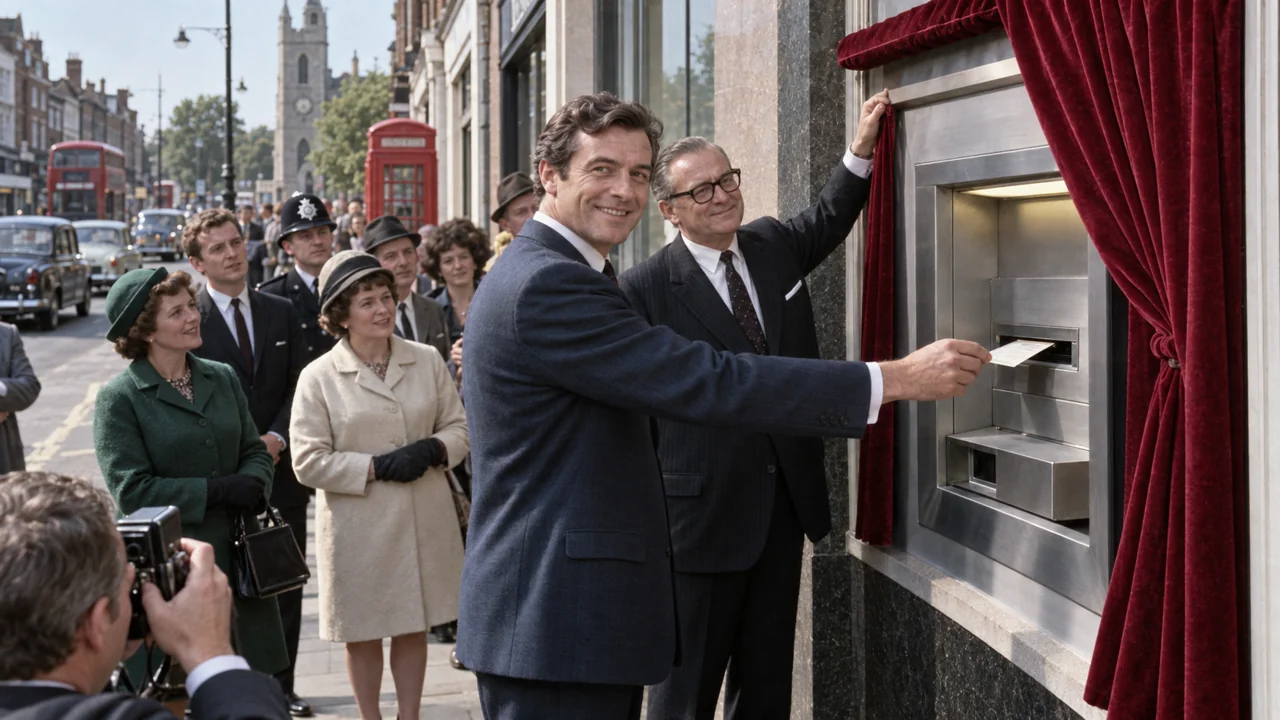
On 27 June 1967, at a Barclays branch in Enfield, north London, a velvet curtain was drawn back from a machine that handed out banknotes with no cashier behind it. To be recognised by it, the customer had to give up a paper voucher impregnated with carbon 14.
A chocolate dispenser, but for banknotes
John Shepherd-Barron was running De La Rue, the British banknote printer, when he reached his bank too late one Saturday morning. He later said the answer came to him in the bath, from thinking about chocolate vending machines. Barclays agreed within days: six machines first, fifty more after that. The first was unveiled on 27 June 1967 in Enfield by the bank's deputy chairman, Sir Thomas Bland, who drew back a velvet curtain; the comedy actor Reg Varney, who lived nearby, made the first withdrawal.
The machine read no card. The customer slid into a drawer a paper voucher, issued in advance by his bank and impregnated with carbon 14, a mildly radioactive marker the machine could detect. He then keyed in four digits. The voucher stayed inside, and the machine paid out ten pounds at most. Branches closed at half past three in the afternoon: that constraint, before any other, was the one being lifted.
Paternity is shared, as it happens. In Glasgow, the engineer James Goodfellow had filed, on 2 May 1966, the application that became British patent no. 1,197,183, granted on 25 July 1967: a machine-readable card paired with a number known to the holder alone. His machines, built by Chubb, were installed that same year at Westminster Bank. The first machine and the first card-borne code do not have the same father.
The four-digit code owes nothing to engineering. A former soldier, Shepherd-Barron first thought of six digits, the length of his army number; his wife Caroline objected that she would never remember more than four. The worldwide standard of the next half-century rests on that domestic exchange.
What a branch was really handing out
A bank branch in 1967 performed two rather different offices: keeping accounts, and handing out cash. The second one took tellers, opening hours, a queue. The machine detached it from the rest, and above all it inverted the cost structure: a counter costs on every transaction, a machine costs once and then serves for almost nothing. A variable cost had just been replaced by a fixed one.
What followed was less obvious than it looks. Making withdrawal free in time did not reduce the number of transactions, it multiplied them. And the machine alone was not enough: for one device to serve everyone, banks had to agree on interconnection, hence a shared infrastructure none of them owns. Handing out cash thus became a quiet commodity, whose cost is only ever debated once it starts to disappear.
It took a machine set into a wall for anyone to notice what a bank branch was handing out first of all.