The king who borrowed
from his subjects
On 27 July 1694, a royal charter created a London company that never sold a single good: it lent money to the state. To finance his war against France, King William III accepted an unprecedented loan, subscribed by the public in barely eleven days.
A loan raised in eleven days
After the naval defeat at Beachy Head in 1690 against the French fleet, William III's England found itself short of credit. The state was borrowing from London's goldsmiths, the only bankers in town, at rates of 20 to 30% a year, a cost the war against France made unsustainable. The Treasury needed fresh funds to rebuild its navy, and at that price few were willing to lend to the Crown for long.
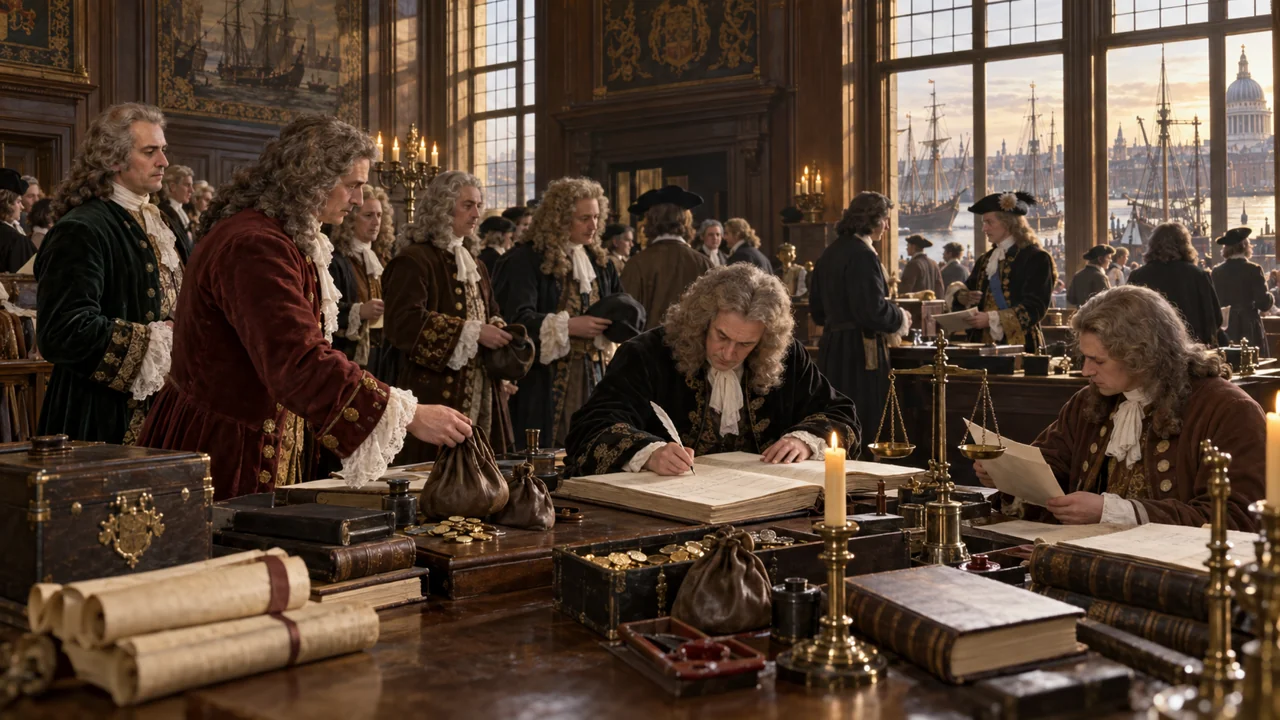
The Scottish merchant William Paterson then proposed an unprecedented arrangement: the public would lend the government £1.2 million directly, at 8% annual interest, far below the goldsmiths' rates. In exchange, the subscribers would be incorporated as a company, "the Governor and Company of the Bank of England," with the right to issue notes. The sum was raised in just eleven days by 1,268 subscribers from every walk of life, and the royal charter was sealed on 27 July 1694. Sir John Houblon became its first governor.
Paterson himself left the Bank's board as early as 1695, after disagreements with his colleagues. He then poured his energy into a far riskier venture: colonizing the Isthmus of Panama to found a Scottish trading post, the "Darien Scheme." The venture turned into disaster, costing his wife and child their lives and ruining Scotland outright; the inventor of the safest loan of his century had signed, with his own hand, one of its most reckless investments.
Borrowing beat confiscating
The episode marks a quiet turning point. Rather than debase its currency or tax arbitrarily, the state chose to borrow from its own subjects, under Parliament's watch, and to repay them faithfully. It was not the bank itself that invented public credit; it was the regularity of repayment, year after year, that turned a one-off war loan into a permanent, tradable public debt. The Bank of England, still a private company in 1694, merely managed a Treasury account; it would not become a lender of last resort for a long time yet, and was only nationalized in 1946.
The lesson outlives the seventeenth century: a state's ability to borrow cheaply rests not on its promise alone, but on the credibility of the institution carrying it. That is the question raised today, in other forms, by central bank independence or sovereign credit ratings: who, exactly, guarantees that a lender will one day be repaid?
A sovereign who repays its creditors ends up borrowing more cheaply than one who ignores them.