The tsar who
taxed beards
In January 1705 Tsar Peter the Great ordered Russians to shave or pay to keep their beards. Behind the picturesque decree lay a state at war in search of money, and a ruler determined to change his subjects' customs.
A tax levied on the face
Back from his journey through Western Europe, Tsar Peter I set out in 1698 to bring Russian customs closer to those of the West, where beards were no longer in fashion. For much of Russian society, however, the beard was a matter of tradition, and sometimes of faith: some saw it as a religious obligation.
The decree of January 1705 ordered beards and moustaches shaved, the clergy excepted. Anyone wishing to keep them had to pay an annual tax scaled to social standing: from 30 to 100 roubles a year, the highest rate falling on the richest merchants. Peasants paid a fraction of a kopeck each time they entered a town. Russia was then at war with Sweden, the treasury was nearly empty, and the beard joined the list of taxable things, alongside baths, beehives and salt.
In return the taxpayer received a copper or silver token to carry on his person. It showed an eagle on one side and, on the other, the lower part of a face with nose, moustache and beard, together with the inscription "Money taken." The tax receipt was worn, quite literally, around the neck, and anyone unable to produce it risked penalties.
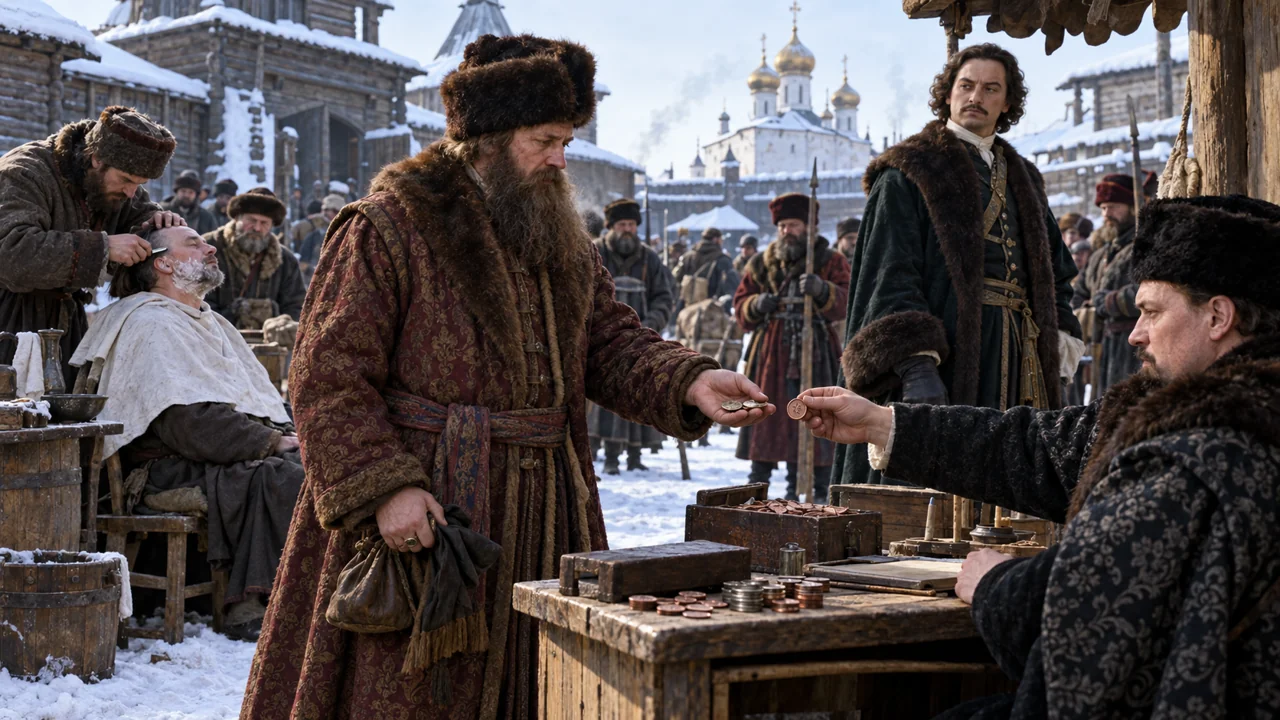
A tax aimed at behaviour
The yield was derisory: around 3,600 roubles a year on average between 1705 and 1708, according to the estimates reported. The Russian historian Evgenii Akelev puts at about a hundred the number of people in central Russia who agreed to pay. Most men chose to shave. As a source of revenue the tax failed; as an instrument for changing customs, it partly succeeded.
The episode illustrates a distinction that still holds between revenue taxation and behavioural taxation. The first aims to fill the coffers; the second to discourage a practice, to the point that its success is measured by how little it raises. Taxes on tobacco, sugar or carbon carry the same ambiguity: can a state count on a revenue it is trying to make disappear? The beard tax was repealed only in 1772, under Catherine II, sixty-seven years after the decree.
A behavioural tax reaches its goal the day it stops raising anything.