The liquidation
that never happened
On 22 July 1944 the forty-four delegations gathered at Bretton Woods signed the Final Act that created the International Monetary Fund and the World Bank. Tucked into it was a fifth resolution, three lines long: liquidate the Bank for International Settlements "at the earliest possible moment". Eighty-two years later, the Basel bank still has not closed.
A death sentence in three lines
The BIS grew out of the Young Plan, adopted on 20 January 1930 at the Hague Conference. A convention signed the same day by six governments and by Switzerland placed it in Basel, in the former Hotel Savoy-Univers on Centralbahnstrasse. Its remit: to collect, administer and distribute the reparation annuities owed by Germany. It opened for business on 17 May 1930. Two years later the Lausanne Agreement cancelled reparations and the institution found itself without a purpose. It fell back on what would become its trade, technical cooperation between central banks.
The war put it in an untenable position: its board brought together central banks of countries fighting one another. In March 1939, days after German troops entered Prague, it carried out an order from the Czechoslovak National Bank transferring part of that bank's gold reserves, held in a BIS account at the Bank of England, to a Reichsbank account; the order had been given under duress. Throughout the conflict it received, in gold, the interest on the German bonds it had bought in 1930. In 1948 it returned the 3.7 tonnes received from the Reichsbank, looted from Belgium and the Netherlands.
The sentence was frailer than it looked. It was not a decision but a recommendation, adopted by Commission III under the heading "Enemy Assets, Looted Property, and Related Matters". The Final Act bound no signatory, and the shareholders of the bank in question were central banks.
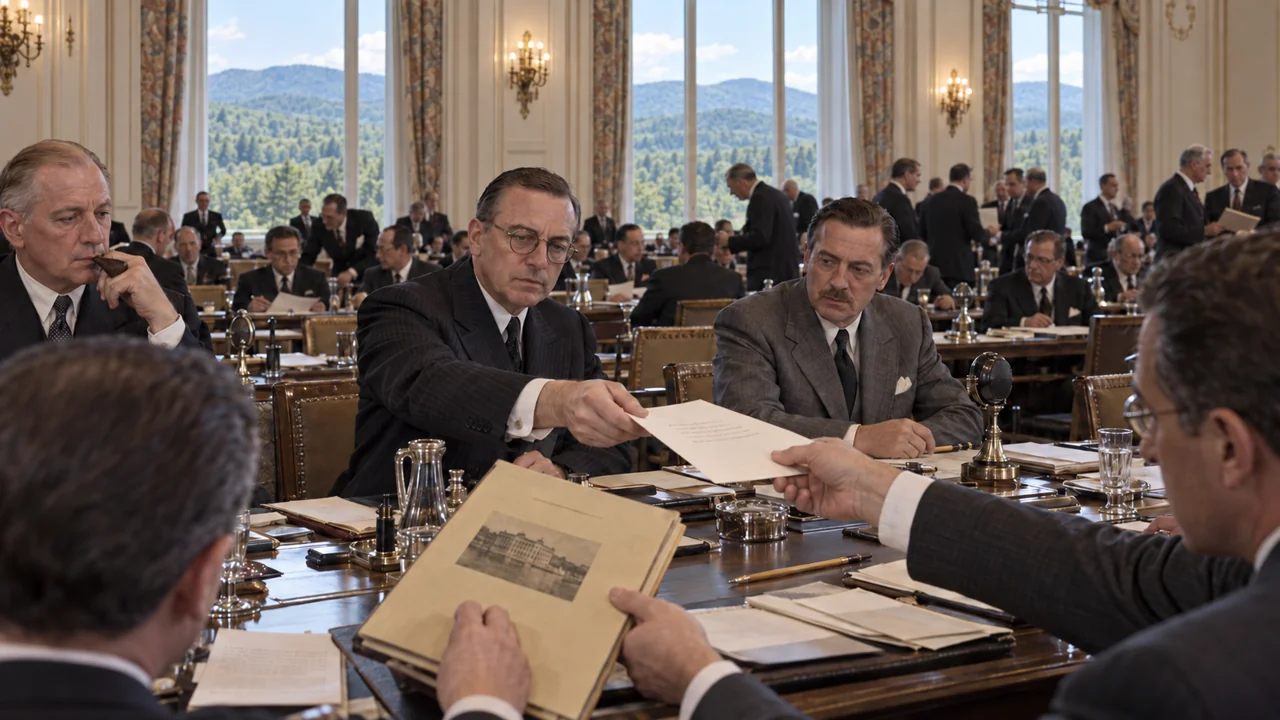
What keeps an institution alive
Europe's governors resumed their Basel meetings as early as December 1946. In November 1947 the Benelux countries, France and Italy made the BIS the technical agent of their first multilateral clearing agreement. By early 1948 the liquidation resolution had been quietly set aside. In September 1950 eighteen countries handed the same bank the European Payments Union. What the Fund and the World Bank were meant to render useless, Europe's treasuries were asking for.
An international institution does not die of a vote: it dies when no one needs what it knows how to do. The BIS was not acquitted, it was made useful. What followed confirms it. The collapse of Herstatt in 1974 led the G10 governors to create in Basel the Basel Committee on Banking Supervision, which published the first capital accord in 1988, then Basel II and Basel III. No treaty gives it any binding power whatsoever.
The one institution the Bretton Woods conference asked to abolish is also the only one that was already there.