The patent that put
a chip in your pocket
On 25 March 1974 a 29-year-old inventor filed a patent for a pocket object that keeps a secret and hands it only to whoever knows the code. Roland Moreno had just invented the smart card, long before commerce found a use for it.
A ring first, a card afterwards
Born in Cairo in 1945, Roland Moreno was a tinkerer who had built a singing mechanical bird and a pocket electric piano. In 1971 Intel produced the EPROM, a programmable, erasable memory, and it gave him an idea: a personal object that holds a piece of data and releases it only once a code is entered. On 25 March 1974 his company Innovatron filed a patent for a memory protected in this way and read by a reader. On 13 May 1975 a second patent, the most important of the forty-three that followed, described the storage and transmission of confidential data by independent portable objects.
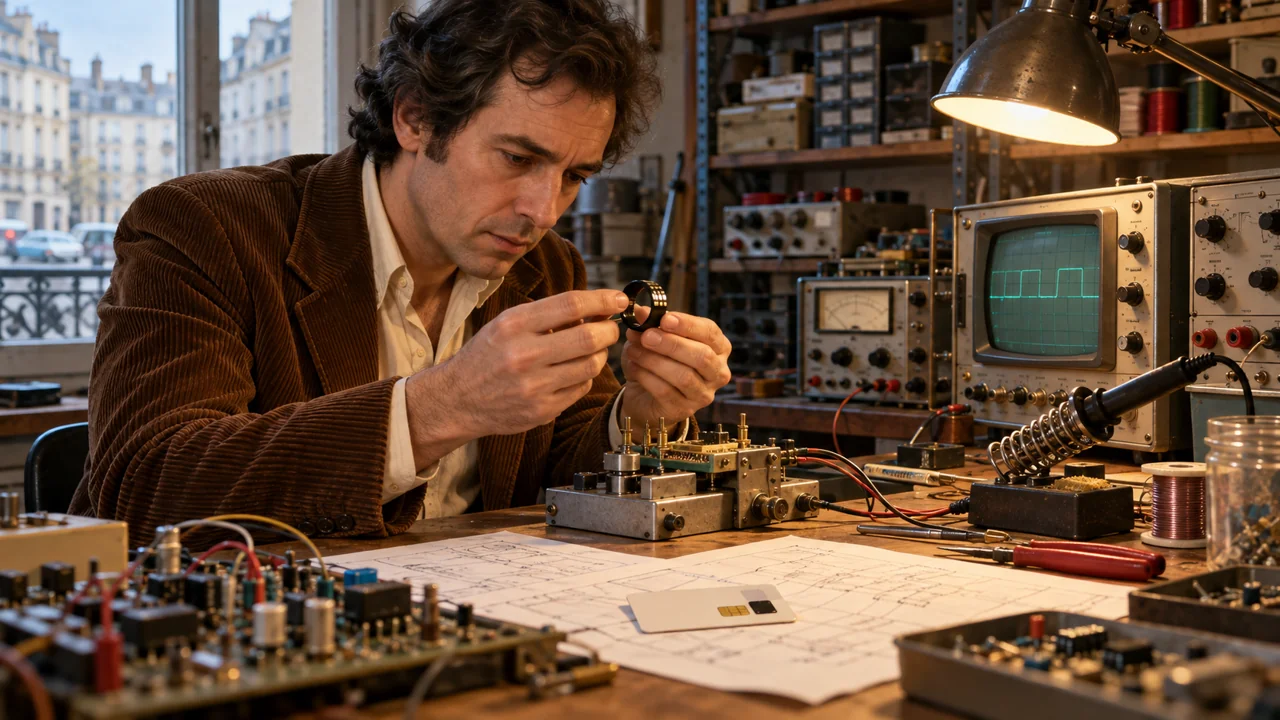
The first prototype was a ring. Inspired by the seals of noblemen, Moreno soldered the chip onto a ring whose pins pressed into a socket to "seal" a document. The object was impractical, but the 1976 demonstration worked. He then fixed the chip to a card slipped into a reader, and named the process TMR, after Woody Allen's film Take the Money and Run.
The market took nearly ten years to arrive. In early 1983 France Télécom rolled out its card-operated phone booths, and the first run of 250,000 phone cards sold quickly. In the early 1990s the Carte Bleue, in circulation since the 1970s, received a chip in turn: according to Moneyvox, France was the first country to make the chip universal on its payment cards. Moreno reportedly earned about 150 million euros from his patents and Innovatron until his death in 2012.
Trust placed in the object
A magnetic stripe merely stores data that can be read and copied. A chip holds a small computer that answers only to the right code: part of the verification moves from the network to the card. The figures reported by Moneyvox for the first half of 2023 give the measure: fraud reaches 0.011% of amounts for a chip payment in person, that is 11 euros per 100,000 euros, against 0.153% for an online payment.
The story also shows that an invention is worth less for its filing date than for the moment an infrastructure awaits it: nine years separate the 1974 patent from the first phone cards, and the EMV standard, adopted in 1998, was still needed for the chip to become an international standard. This path lights up current debates, from phone payments to digital identities: should trust reside in a network, in an institution or in the object one carries?
A patent can wait nearly ten years for the world to need it.