When the cigarette
became money
In 1945 a British economist published a study of a prisoner-of-war camp where nobody earned a wage and everybody traded. The standard of that small world fitted in a pocket: the cigarette.
A currency born without a decree
Captured in Libya in 1942, R. A. Radford spent the rest of the war in German camps. There he watched what theory usually teaches on paper: men with no state and no bank who began to trade. In November 1945 he published his observations as “The Economic Organisation of a P.O.W. Camp” in the journal Economica.
Everyone received roughly identical Red Cross parcels: tinned milk, jam, butter, biscuits, tinned beef, chocolate, sugar and cigarettes. Tastes, however, differed. The non-smoker gave up his cigarettes, the sweet tooth his chocolate, and barter took hold. Very soon one good became the common yardstick: the cigarette, uniform, durable and divisible. A laundered garment cost about two cigarettes, a cup of tea, coffee or cocoa at the camp stall about the same.
Prices behaved as in any market. A mere rumour of parcels once lifted treacle from three cigarettes to four within minutes; the price fell back as soon as the rumour was denied.
Gresham's law applied too. Popular brands were smoked, while the poorer ones circulated. Worse, cigarettes hand-rolled from pipe tobacco, varying in size and quality, swelled the money supply: the currency debased, prices rose, until people went back to factory-made cigarettes.
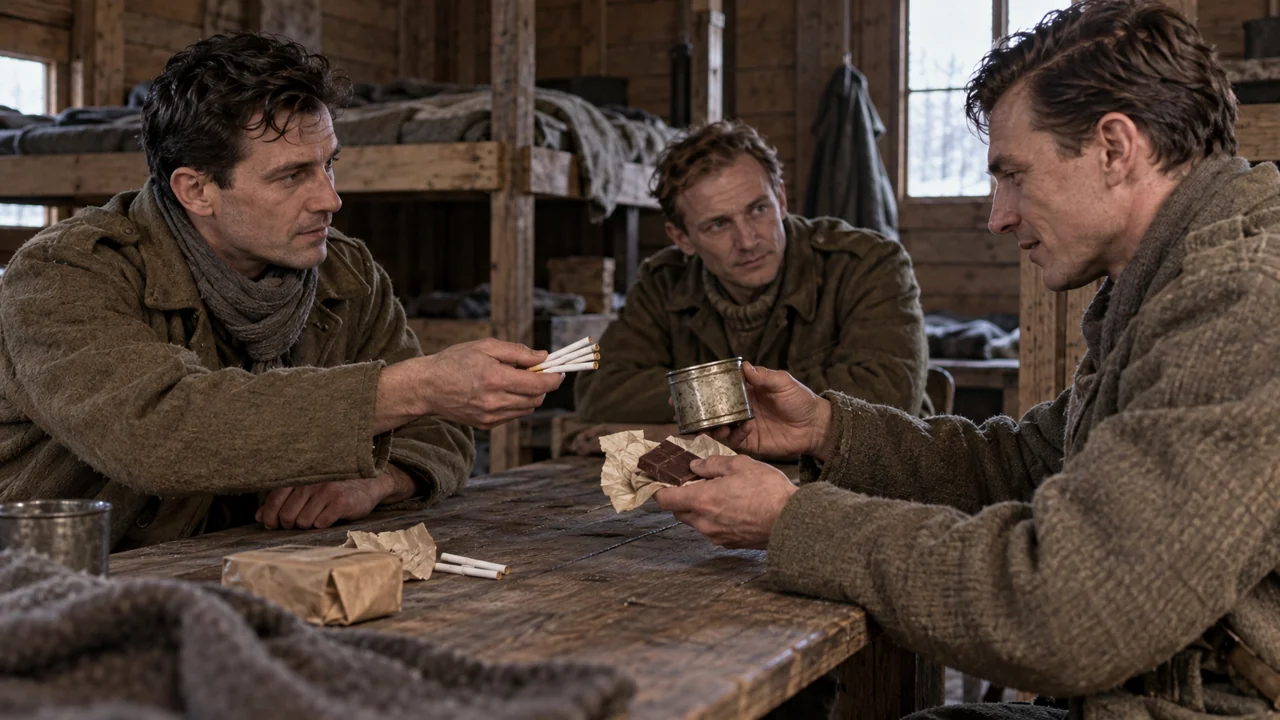
What money owes to scarcity
The camp was an almost laboratory experiment. Radford saw a commodity money: the cigarette served as unit of account, means of exchange and store of value, yet it also went up in smoke, which made it unstable. Prices rose when parcels arrived and sagged as stocks ran down.
The camp administration opened a shop and a restaurant, and used a paper currency backed by food. While supplies stayed regular, order held. In August 1944 parcels and cigarettes were halved; in early 1945 stocks ran out, prices collapsed and the shop's price scales became untenable. Only bread kept its value.
The lesson reaches beyond the barbed wire. A currency is worth the trust placed in its scarcity and in the regularity of its supply: too much issue debases it, too little chokes it. No decree had named the cigarette; usage chose it. Today's debates on private or digital money ask the same question.
A few men, a scarce good and a little trust are enough for a currency to be born, and a shortage is enough for it to die.