The treaty signed
in secret
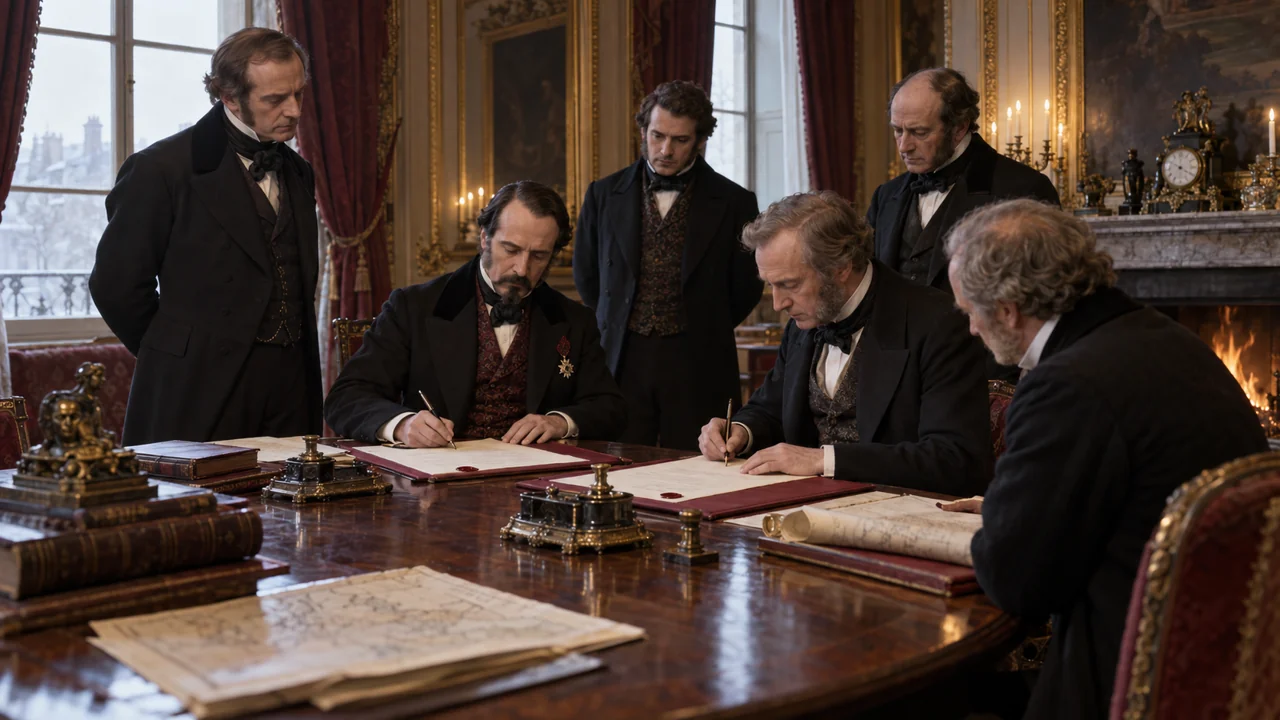
On 23 January 1860, France and the United Kingdom signed a trade treaty negotiated in the strictest secrecy. Napoleon III lifted import bans that had stood for decades, without consulting either the manufacturers or Parliament.
A customs revolution decided by the executive
Since the start of the century France had protected its industry with prohibitions: many British goods, including wool and cotton fabrics, simply could not enter. An attempt at liberalization had met Parliament's refusal in 1856. At the end of 1859 Napoleon III found a way around it: a treaty falls within the executive's power. The talks, led by the liberal economist Michel Chevalier and the British MP Richard Cobden, stayed secret to the point that, apart from the Emperor, only five people in France knew of them.
The text was signed on 23 January 1860. France admitted 44 categories of British goods previously banned, with duties capped at 30% of value, then 25% from 1 October 1864. The United Kingdom abolished or cut its duties on 41 products, silk fabrics among them, and progressively lowered those on wines and spirits. The treaty ran for ten years.
The decisive mechanism lies in Article 19: the unconditional most-favoured-nation clause. Any customs advantage later granted to a third country had to be granted to the other signatory as well. Each agreement France concluded afterwards therefore extended the duty cuts to all its partners, and a treaty between two states gradually became a network. The United Kingdom would sign eight treaties of this kind in the 1860s.
Opening up without collapsing
Protectionists predicted the ruin of manufacturers. The figures say otherwise. The average rate of French duties fell from about 11% in 1859 to 5% in 1861; cognac exports leapt from 150,000 hectolitres in 1860 to 421,000 in 1866; two-way trade in products of the same branch, such as cotton, wool or silk fabrics, rose from about 14% of French trade in 1859-1860 to 38% in 1872. France imported more without selling less abroad.
What followed is a reminder that openness is a political choice, and so reversible. Protectionist pressure appeared from 1878, and France ended the regime in 1892 in favour of the Méline tariff. In between, the treaty left a lasting model: a bilateral agreement, a clause that multiplies it, an executive that commits the country without waiting for the assembly. The most-favoured-nation clause still sits at the heart of the rules of world trade: how far should an opening negotiated by two benefit everyone?
Free trade owes less to a doctrine than to a signature, and a signature can be withdrawn.