The pack of gum
that launched the barcode
At 8:01 a.m. on 26 June 1974, a checkout in Troy, Ohio, read a commercial barcode for the first time. The item scanned was a pack of chewing gum. What was recorded that morning was not a price: it was a new way of knowing what you sell.
A pack of gum, at one minute past eight
The idea goes back to 1949. On 20 October, Norman Joseph Woodland and Bernard Silver applied for a patent on a pattern of lines a machine could read, the principle of which Woodland had sketched in the sand of a Miami beach. The patent was granted in 1952, but the electronics of the day could not exploit it at a reasonable cost.
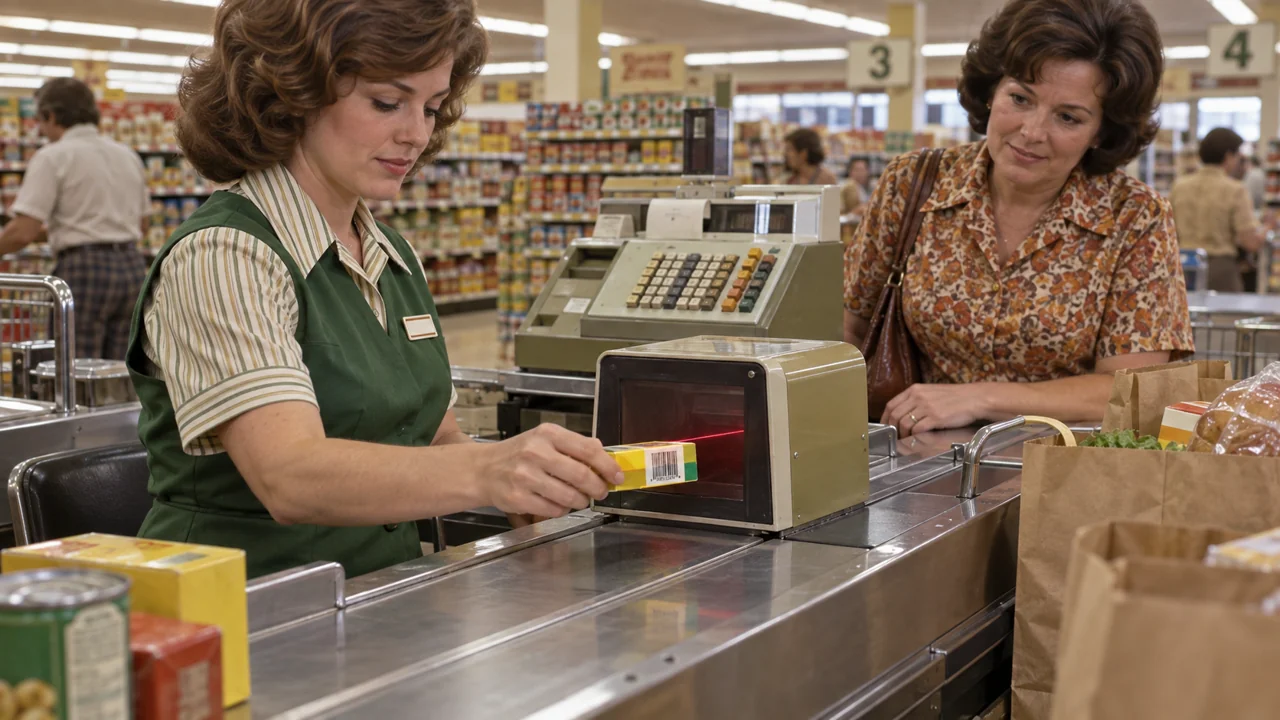
The industry had to get organised first. A committee of retailers and manufacturers met in 1970 to choose a common symbol. On 3 April 1973 it picked, from seven proposals, the rectangular pattern designed by George Laurer, an IBM engineer: the Universal Product Code. Practice remained. On 26 June 1974, in a Marsh supermarket in Troy, Clyde Dawson, the company's head of research and development, passed a pack of Wrigley's Juicy Fruit across the scanner. The checkout identified the product.
The striking detail: the code does not contain the price. It carries only a number identifying the manufacturer and the product. The price is stored in the store's computer, where a single click changes it without touching a single item. The price leaves the label stuck on the box and enters a file.
When the price becomes data
The barcode first solved a coordination problem before it solved a technical one. A manufacturer had no reason to print a symbol that no store could read, and a store no reason to buy scanners when products carried no symbol. It took a common standard, chosen in advance by the whole industry, to break the deadlock. Even so, adoption was slow: by the end of the 1970s only about 1% of American grocery stores had equipped themselves, and more than half did so roughly ten years later.
The economic reach goes well beyond the checkout. Every pass becomes an observation: what sells, at what hour, at what price. Stocks can be followed almost in real time, shelves are restocked on recorded rather than assumed sales, and chains negotiate with suppliers from precise figures. Modern mass retail, with its thin margins and tight logistics, rests on this small rectangle of bars. The same logic runs through today's debates on traceability, consumption data and platform standards: whoever fixes the shared language fixes the terms of the game.
Before it changed the way we sell, the barcode changed the way we know what we sell.