The wheat tariff that
brought down a prime minister
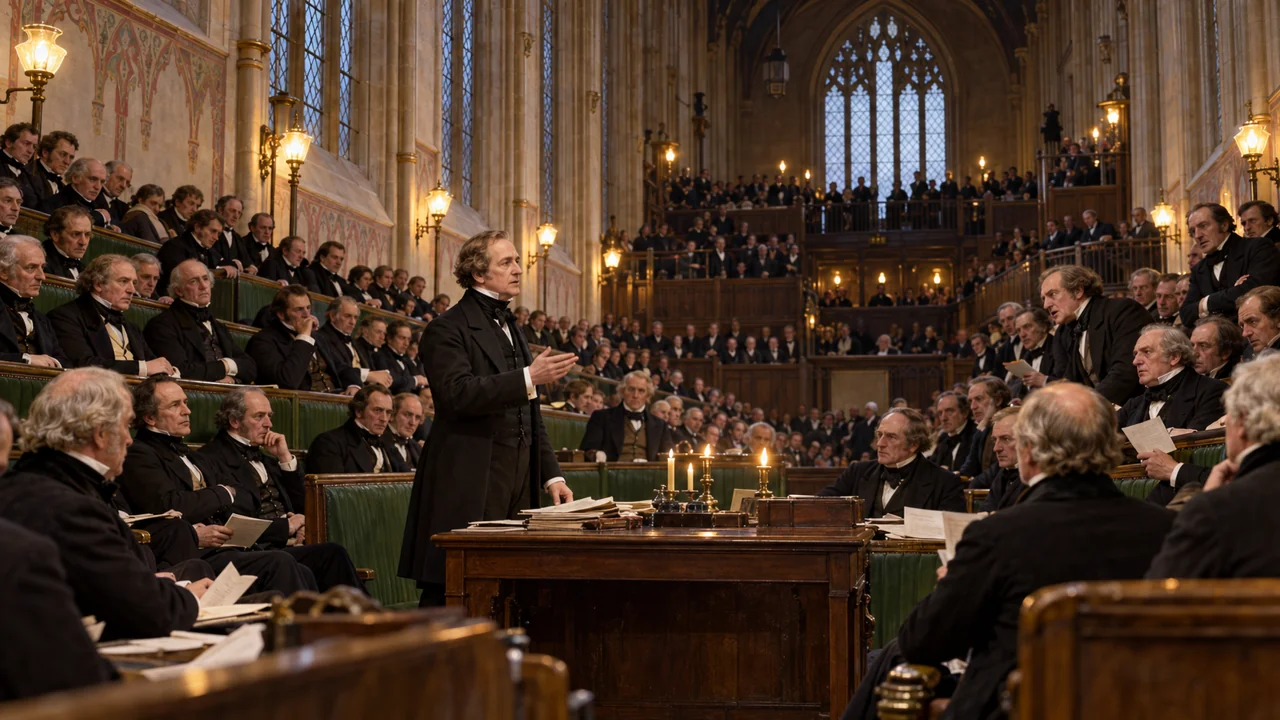
On 25 June 1846 the House of Lords passed the repeal of the Corn Laws, the tariffs that had shielded British grain since 1815. The prime minister who carried it, Sir Robert Peel, sacrificed his own party to do so, and the United Kingdom tipped toward free trade.
A protected loaf, a sacrificed party
In 1815, at the end of the Napoleonic Wars, Parliament passed a law closing the market to foreign wheat as long as the domestic price stayed below 80 shillings a quarter. Landowners, who dominated Parliament, found in it an insurance for their rents. Workers and manufacturers saw dearer bread. In 1838-1839, in Manchester, the Anti-Corn Law League was born: Richard Cobden and John Bright turned it into a pressure campaign of a new kind, built on meetings, petitions and pamphlets.
Peel, leader of a Conservative party anchored in the land, had nevertheless been brought to power to defend these duties. Then the Irish potato crop was ruined in 1845, and protecting grain became indefensible. On 27 January 1846 he announced a gradual abolition, with the duty falling to a mere shilling a quarter on 1 February 1849. The Commons passed the bill on third reading on 15 May, by 327 votes to 229, despite the hostility of much of Peel's own camp; the Lords followed on 25 June.
That same evening, 25 June, the Commons rejected by 292 votes to 219 the Irish coercion bill Peel supported: Conservatives opposed to repeal joined the opposition to bring him down. He resigned a few days later, and his party split for years. The man had passed the most important measure of his career knowing it would cost him power.
A protection that is paid for elsewhere
The Corn Laws were not only about wheat: they redistributed. They guaranteed a high price to a small, powerful group, the landowners, at the expense of a vast, scattered one, the consumers. A 2021 study concluded that repeal benefited the bottom 90% of earners and cost the top 10%. By the usual estimates, Britain's dependence on food imports rose from about 2% in the 1830s to 45% in the 1880s, and agriculture's share of national income fell from about 17% in 1871 to under 7% in 1911.
The case also shows why a protection is so hard to undo: those who live off it organize, those who pay for it rarely do. It took a methodical campaign, then a famine, for the calculation to flip. Today's debates over tariffs, food sovereignty or farm protection rest on the same question: who pays for the security guaranteed to a few?
A tariff always protects someone, and the price of that protection is always paid elsewhere.