The forgotten wallet
that gave birth to the card
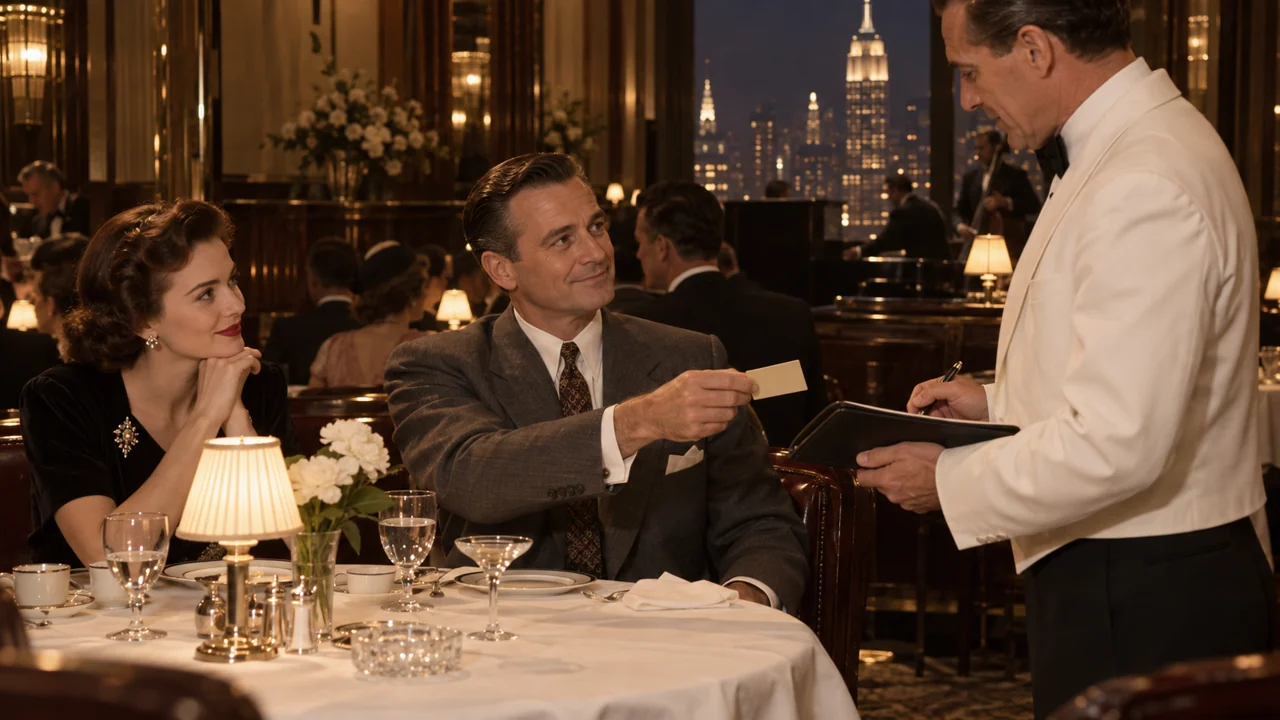
In February 1950, in New York, a few diners settled their bill with a simple piece of cardboard and a signature. The Diners Club had just been born: the first payment card accepted by several establishments, at a time when one paid only in cash, by cheque, or on an account opened with each merchant.
A card, a signature, twenty-seven restaurants
According to the company's own account, Frank McNamara, a New York businessman, found himself in 1949 at a Manhattan restaurant without his wallet and had to send for someone to settle the bill. The anecdote is probably embellished, but the problem was real: in 1950 a customer had only cash, a cheque, or a separate account opened with each merchant, whether department store, hotel or filling station.
McNamara teamed up with Ralph Schneider and founded the Diners Club in February 1950. The principle came down to three gestures: the holder presented a cardboard card at an affiliated establishment, signed the bill, and the club then paid the restaurant and collected from its member. The customer no longer needed cash on hand, and the merchant was sure to be paid.
Growth was rapid: 20,000 members by the end of 1950, 42,000 a year later, acceptance abroad as early as 1953 (United Kingdom, Canada, Cuba, Mexico), a million holders in 1959. McNamara himself sold his stake to his partners in 1952 for $200,000. The plastic card did not appear until 1961.
The arrangement rests on a triangle: the holder, the merchant, the issuer. At launch, some two hundred holders, acquaintances of the founders, paid an annual fee of $5, and twenty-seven New York restaurants accepted the card in return for a 7% commission on each bill. The club was paid from both sides: the customer paid for convenience, the restaurant paid for the clientele brought to it.
The real product is a third party's trust
The card was not yet credit in the modern sense: the Diners Club was a payment card whose bill had to be settled in full. Its contribution lay elsewhere. The issuer stepped in between two strangers: it vetted the customer on the merchant's behalf and guaranteed the merchant a payment he would never have dared expect from a passing customer. The restaurateur's personal trust in his regular became an organised trust, transferable from one establishment to another.
The episode also reveals the difficulty of every payment network: a card has value only if merchants accept it, and they accept it only if holders are numerous. The founders broke this circle by seeding both sides at once, with a few hundred friends and a few dozen tables. The reasoning still holds, from bank cards to phone wallets, and feeds today's debates on interchange fees and the concentration of payment networks. In 1958, in Fresno, the BankAmericard would extend the idea by adding revolving credit: cashless payment became a loan as well.
To pay without money in your pocket is to entrust a third party with believing in your place.