The franc born of
a declaration to the IMF
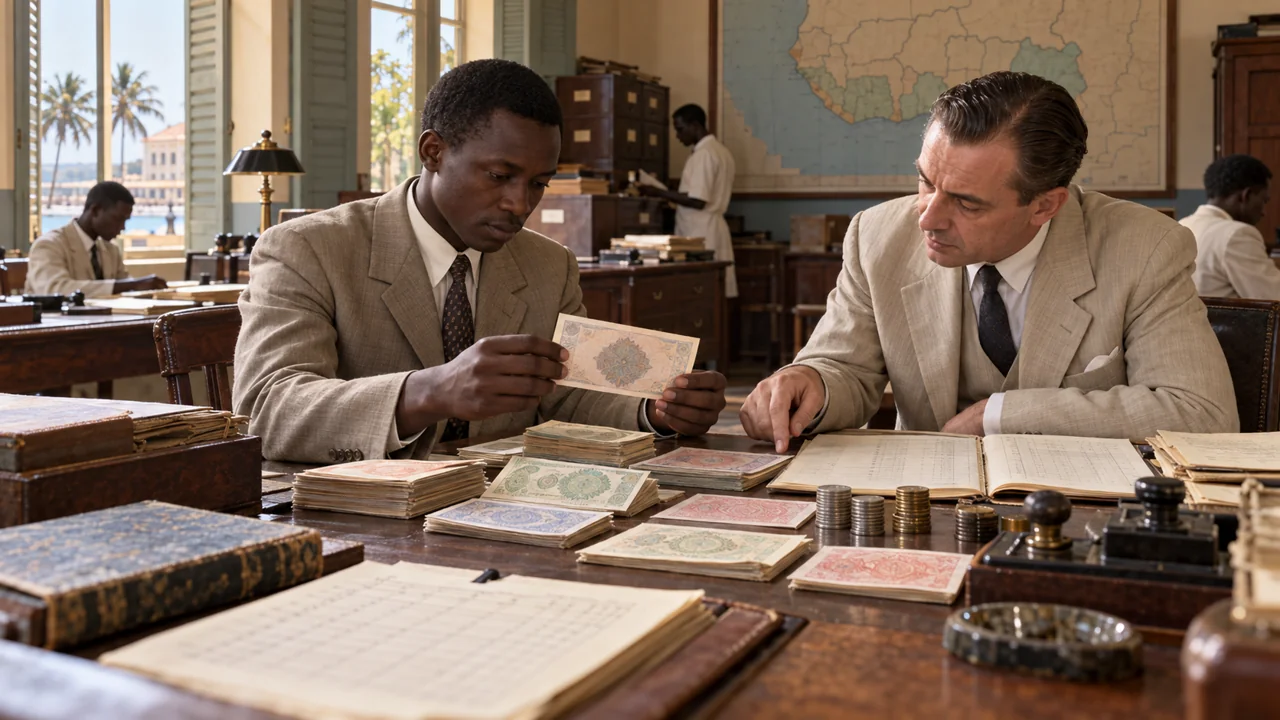
On 26 December 1945, the very day France ratified the Bretton Woods agreements and declared its first parity to the International Monetary Fund, the franc of the French Colonies of Africa was born. A currency created by a procedural detail, which would outlive the empire that saw it begin.
A currency spared the devaluation
At the end of 1945 the French franc was weakened by the war. By ratifying Bretton Woods, France had to declare a parity to the IMF, and it devalued its franc. The colonies of Africa were spared: they were given a currency of their own, the franc of the French Colonies of Africa, worth 1.70 metropolitan francs. The same day saw the birth of the CFP franc for the Pacific territories.
The premium had a flip side. A strong African franc made imports from France cheaper and exports to the mainland harder to sell. The decision was presented at the time as a gesture of generosity from the metropole. The parity then followed the French franc: two metropolitan francs per CFA franc from October 1948, then, after the 1960 redenomination, 0.02 new francs.
On 12 January 1994 the parity was halved overnight: the CFA franc was now worth only 0.01 French francs, or one hundred CFA francs to the franc. Five years later, on 1 January 1999, the peg moved to the euro at 655.957 CFA francs to the euro, which is simply the French franc's conversion rate (6.55957) multiplied by one hundred.
A rate that was never quite its own
The CFA franc shows what a fixed parity costs and what it brings. It brings generally moderate inflation and convertibility guaranteed by a third state; in return, it removes the ability to adjust the exchange rate to a shock specific to the zone. In 1994 the shock came precisely from there: a parity that had become untenable was corrected in one stroke, by half.
The zone today has fourteen countries and about 210 million inhabitants (2023), split between two central banks, the BCEAO in Dakar and the BEAC in Yaoundé. The debate it provokes pits those who see an anchor of stability against those who see a tutelage inherited from colonisation. It is a reminder that a currency is never only a technical instrument: it carries a history, relations of power, and the question of who decides its parity.
Eight decades on, the same question remains: who owns a currency's parity?