The professor who lent
twenty-seven dollars
In 1976, economist Muhammad Yunus lends twenty-seven dollars from his own pocket to forty-two artisans in the village of Jobra, Bangladesh, with no collateral whatsoever. That handful of bills would give rise to microcredit and the Grameen Bank.
A trade that enriched only the lender
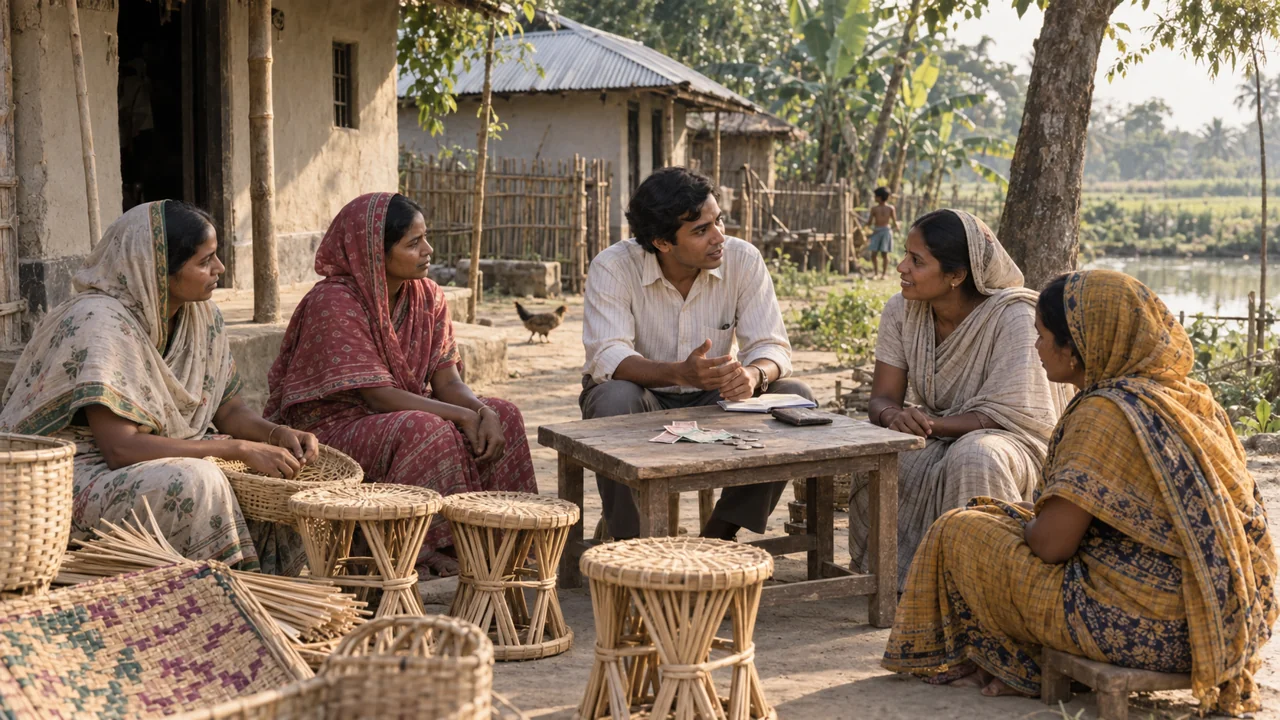
An economics professor at the University of Chittagong, Muhammad Yunus watches famine strike Bangladesh in 1974 while the models he teaches in the lecture hall say nothing of the destitution he crosses paths with the moment he steps off campus. Two years later he visits the nearby village of Jobra and finds artisans making bamboo stools: to buy their raw material, they borrow from middlemen who then buy back the finished stools at a price fixed in advance. The gap between the two barely covers the loan; it leaves them only a handful of cents in profit a day.
Yunus draws up a list of forty-two artisans trapped this way. Their combined debt amounts to a trifling sum: eight hundred fifty-six taka, the equivalent of twenty-seven dollars. He lends it to them out of his own pocket, with no collateral and no paperwork, on nothing more than the promise of repayment. Freed from the trader's advance, the artisans sell wherever they choose and keep their margin; every one of them repays.
The idea Yunus draws from it fits in one sentence: credit is a human right, not a privilege reserved for those who already own something to pledge. The loan comes with no collateral, but rarely alone: small groups support and watch over one another, peer pressure standing in for a bank guarantee.
Trust as collateral
The Jobra experiment becomes a project, then a bank: on 2 October 1983, an ordinance of the Bangladeshi government turns the program into an independent institution, the Grameen Bank ("the bank of the village"). By 2006 it counts more than seven million borrowers, over 95% of them women, with a repayment rate above 95%; that same year the Nobel committee jointly honors Yunus and his institution "for their efforts to create economic and social development from below."
The model travels, but not always with its safeguards intact. Copied by for-profit operators less careful about rates and collection methods, it produced, in the Indian state of Andhra Pradesh in 2010, a wave of over-indebtedness severe enough to force authorities into emergency regulation of the sector. An idea born to free borrowers from predatory lenders can, once detached from the trust it rested on, reproduce their effects: microcredit remains a tool, not a virtue in itself.
To lend with nothing to seize is to bet that trust is worth more than a pledge.