The failure that revealed
a time zone
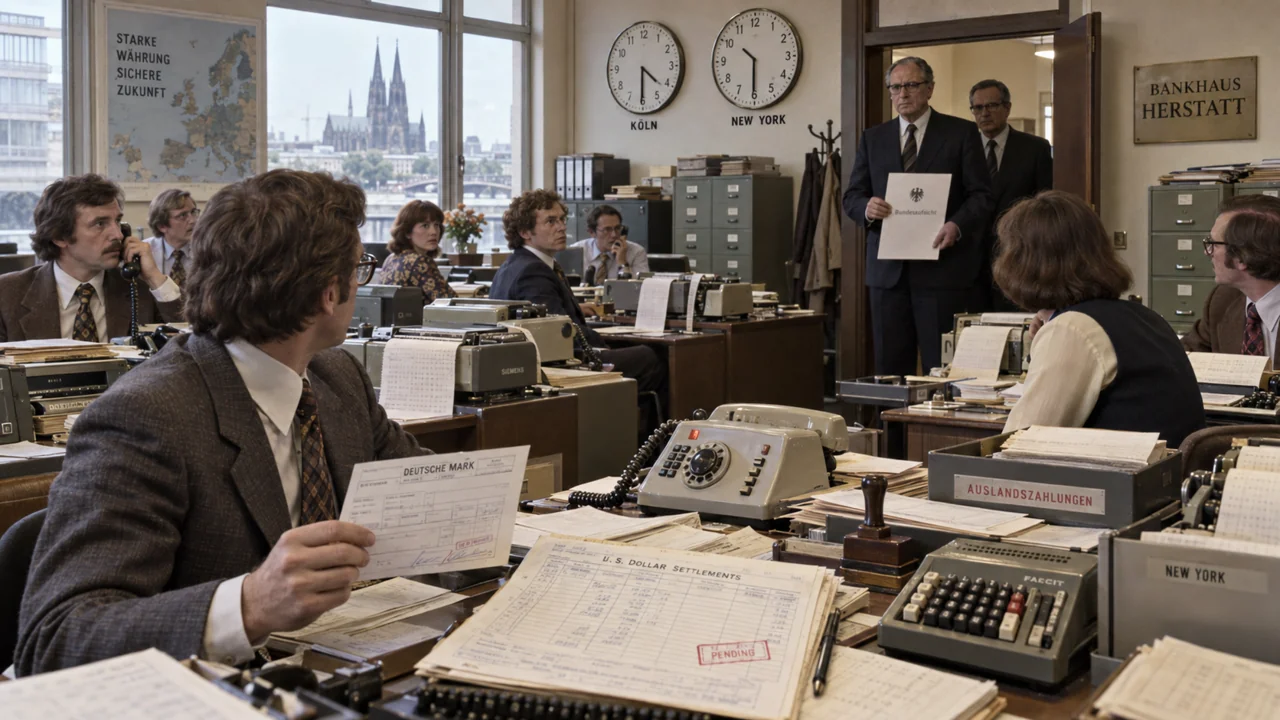
On 26 June 1974, at 4.30 pm, a private bank in Cologne lost its licence. In New York it was only 10.30 am: its counterparties had already paid their marks and had not yet received their dollars. A modest failure was about to give its name to the most brutal risk in banking.
One bank, two clocks
Bankhaus I. D. Herstatt was a family house in Cologne whose trading desk had taken large positions on the dollar after the collapse of the Bretton Woods system and the shift to floating rates. The dollar went the other way. By the spring of 1974 the losses reached some 470 million marks against capital of 44 million. On 26 June the German federal banking supervisory office withdrew the licence and ordered liquidation, with effect from 4.30 pm.
The hour was everything. Banks that had dealt foreign exchange with Herstatt had settled their mark "leg"* that same morning in Frankfurt, against dollars due later in the day in New York, where it was still only 10.30 am. The American correspondents immediately stopped outgoing payments from the failed bank's account. The dollars never came, and the counterparties, deprived of what they were owed, in turn stopped paying their own.
A foreign exchange trade is made of two payments, in two currencies, in two countries, on two clocks. As long as the two legs are not simultaneous, whoever pays first lends the other party, for a few hours, not a price difference but the entire principal. That risk has borne the name of the Cologne house ever since: Herstatt risk.
Settlement is not a technicality
Measured against the crises that followed, the sum is trifling; the consequences are not. At the end of 1974 the central bank governors of the Group of Ten set up a committee on banking supervision in Basel, which met for the first time in February 1975. The finding was simple: no authority had felt responsible for a bank whose commitments crossed borders. From that committee would come the Basel accords and the very idea of coordinated capital requirements.
The second lesson took nearly thirty years. Since the danger lies in the gap, the gap had to go: deliver each leg against the other, or neither. On 9 September 2002 the CLS platform began settling foreign exchange this way for thirty-nine banks in seven currencies. The principle reaches beyond currency trading: whenever a payment and its delivery are not simultaneous, someone carries the whole amount for the interval. That is precisely what today's instant settlement projects are arguing about.
Risk does not always live in the price. Sometimes it lives in the plain interval between paying and receiving.