The Thursday the
silver bet collapsed
On Thursday 27 March 1980, the price of silver collapsed to about $11 an ounce, after nearly touching $50 in January. Behind the fall stood two Texas brothers who had bought the metal on a scale the market had never seen.
An inflation bet on an unprecedented scale
In the late 1970s American inflation was eating away at the dollar and savers were seeking refuge in metals. Two Texas brothers, Nelson Bunker and William Herbert Hunt, heirs to an oil fortune, had been buying silver since 1973. By the end of 1979, with partners, they held nearly 200 million ounces, half of it in futures contracts. The price went from about $9 an ounce in July 1979 to nearly $50 in January 1980.
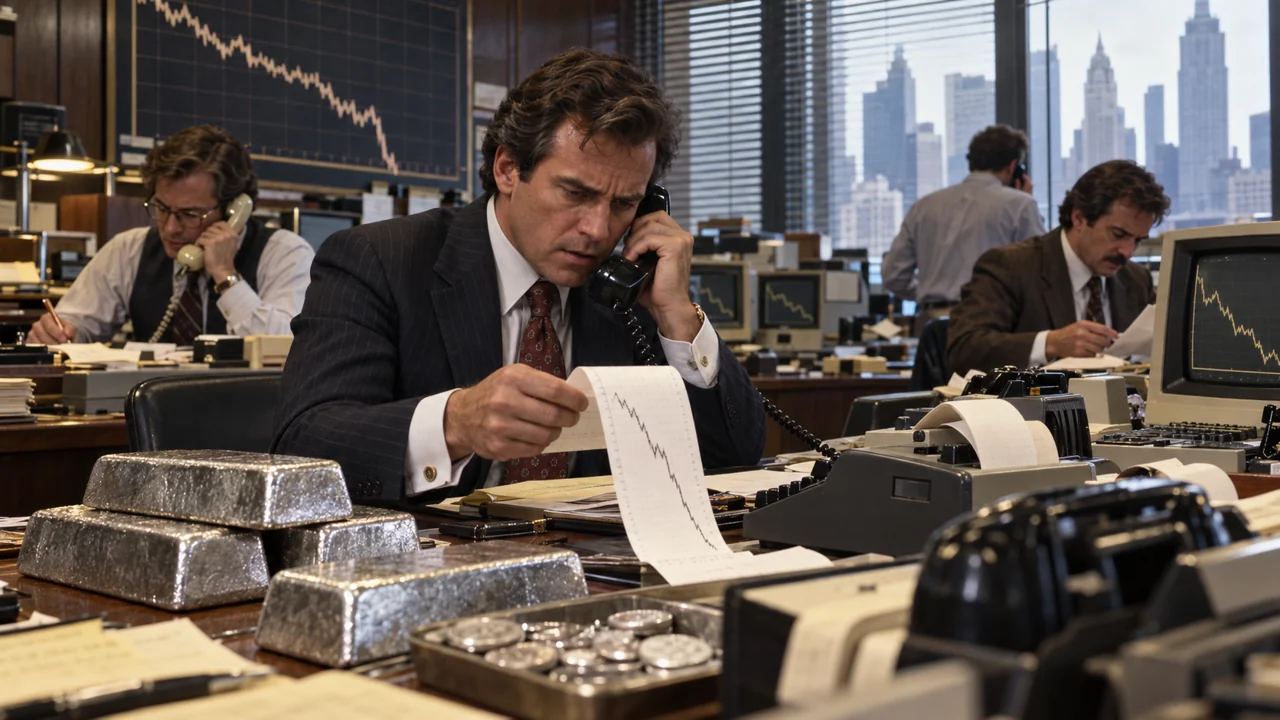
The market authorities finally reacted. On 7 January 1980 Comex, New York's metals exchange, capped silver positions; on 21 January it allowed only liquidation and hedging orders. Buyers could no longer enlarge their positions, the rise lost its fuel and the price ebbed. From $29.75 on 10 March it fell to $10.80 on 27 March: "Silver Thursday."
That day the Hunts could not meet their margin calls, the security deposits brokers demand when prices fall. Their broker Bache was left exposed to an unsecured shortfall of about $122 million, and the US regulator suspended trading in Bache's stock from 27 March to 1 April. A consortium of thirteen banks then lent $1.1 billion to Placid Oil, the family company, secured on oil fields, refineries and pipelines.
A position too big to exit
The mechanism is that of every corner: the more metal you hold, the narrower the exit, because each sale lowers the price of what remains. The leverage of futures contracts, which lets you bet more than your capital, turns a decline into margin calls, hence into forced sales. The Hunts' bet did not need to be absurd to become fatal: it only had to be too big and too indebted.
The affair left rules and lawsuits behind. In 1988 a federal jury found that the Hunts had conspired to corner the silver market, and the two brothers sought Chapter 11 protection the same year. It lights up debates that remain current, from position limits on commodities to margin calls in derivatives markets: can an exchange change its rules mid-game, and who benefits from the change?
Owning a whole market is worth nothing if you can no longer resell it to anyone.