The day freight went
into a box
On 26 April 1956, a converted tanker left Port Newark with fifty-eight metal boxes lashed to her deck. No ceremony, no speeches: the cost of handling cargo in a port had just been cut by a factor of thirty-seven.
Fifty-eight boxes on a tanker's deck
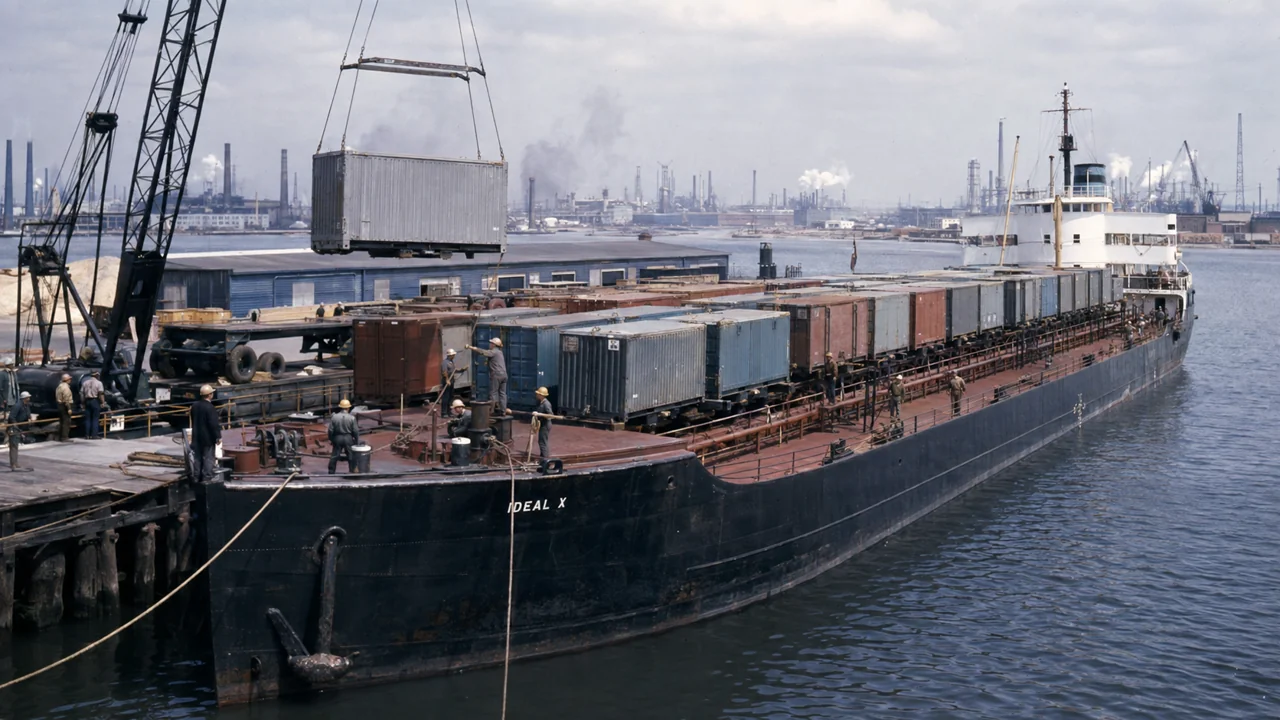
Malcom McLean was no shipowner. A North Carolina trucker, he spent his days watching longshoremen empty his lorries crate by crate to fill a ship's hold. In 1955 he sold his trucking firm and bought the Pan-Atlantic Steamship Company, then had a wartime T-2 tanker, the Potrero Hills, rebuilt and renamed Ideal X: a platform was laid across her oil tanks.
On 26 April 1956, fifty-eight thirty-five-foot boxes, trailer bodies lifted off their running gear, were hoisted aboard at Port Newark. Loading took under eight hours, where an ordinary freighter would sit at the quay for days. Five days later she docked in Houston and the boxes rolled straight onto waiting trucks. The invention was not the box, which already existed; it was never touching the goods again between shipper and consignee.
One figure captures the shift. Loading the Ideal X cost roughly 15.8 cents a ton, against about $5.83 a ton for break-bulk cargo on an average ship. A ratio of one to thirty-seven, on a cost that often weighed more than the ocean crossing itself.
Globalization did not begin with a treaty
The opening of trade is usually told through diplomacy, customs accords and falling tariffs. Yet economic geography moves above all when the cost of transport collapses. As long as shipping was expensive, producing far away made no sense: you manufactured near your customer. Once freight becomes almost negligible in the final price, it turns rational to make things where production is cheapest and sell them on the other side of the world. Long supply chains are born of that gap.
The bill was paid elsewhere. Historic ports, too cramped for gantry cranes and acres of stacking yard, went into decline; Manhattan and the London docks lost their traffic to deep-water terminals. Dockside trades were gutted. It also took more than a decade of negotiation to standardize the box's dimensions: without a common standard, no network effect, and so no revolution. Even now this infrastructure becomes visible only when it jams, a blocked canal or a saturated port being enough to remind us what a metal box makes possible.
World trade did not open by decree: it opened because a metal box made distance cheap.