A duck hunt
that was not one
In November 1910, six men slip quietly out of New York for an island off Georgia, officially to hunt ducks. They come back with the blueprint of an American central bank, which Congress will adopt, reworked, three years later.
A central bank drafted in secret
The United States had had no central bank since the 1830s, and the panic of October 1907 showed what that cost: with no lender of last resort, the banker J. P. Morgan had to gather the financiers himself to plug the failures. In 1908 Congress set up a National Monetary Commission, chaired by Senator Nelson Aldrich of Rhode Island, to propose a reform.
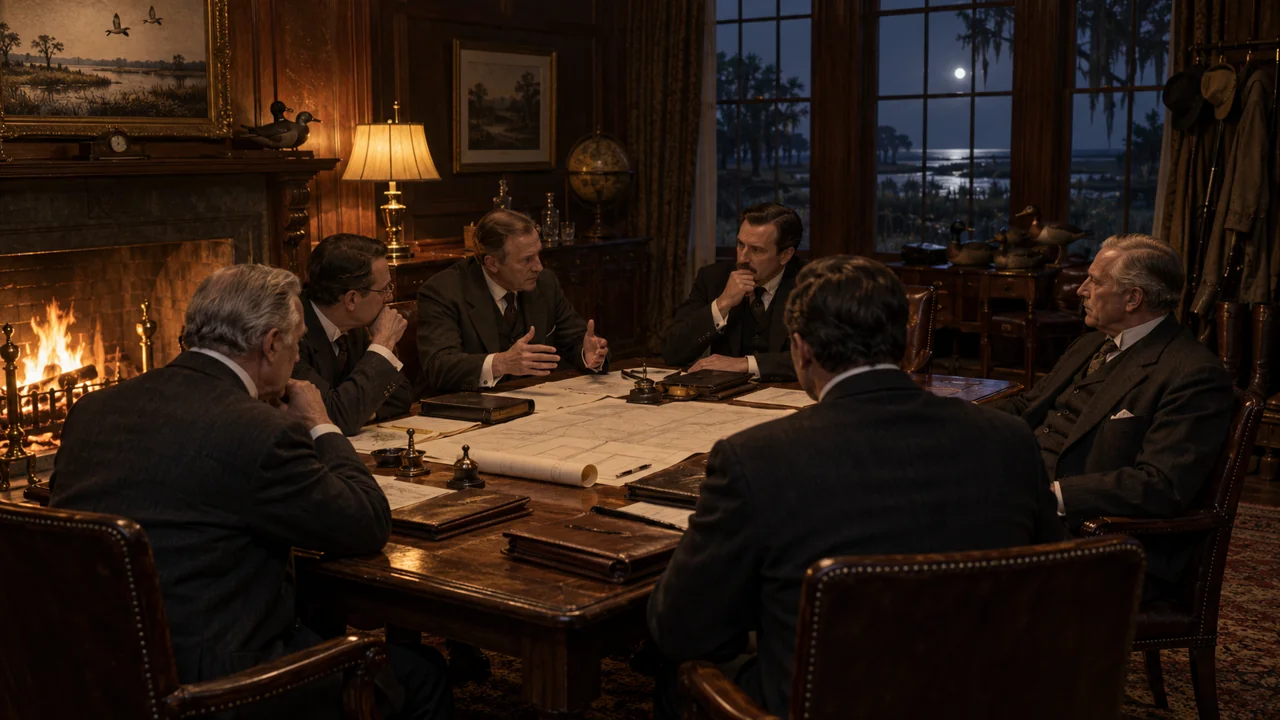
In November 1910, Aldrich took five other men to Jekyll Island, off the coast of Georgia: two of the Commission's collaborators, A. Piatt Andrew and Arthur Shelton; the bankers Henry Davison and Frank Vanderlip; and Paul Warburg, a financier of German origin. They boarded Aldrich's private railway car one at a time, at a New Jersey terminal, on the pretext of a duck hunt, and used only first names so that the staff could not identify anyone. For more than a week they worked late into the night.
They came back with the plan for a "Reserve Association of America": a single bank with fifteen branches, which would hold the member banks' reserves, issue currency, discount commercial paper and run check clearing. Presented to the Commission in January 1911 as the National Reserve Association, the plan was never voted as it stood: many saw in it the hand of Wall Street.
After the Democratic victory of 1912, President Woodrow Wilson kept the technical backbone of the project but changed who controlled it: not one bank but twelve regional ones, topped by a board of governors appointed in Washington. The Senate passed the Federal Reserve Act on 23 December 1913 by 43 votes to 25, and Wilson signed it the same day, at 6 p.m.
An institution born of compromise
The episode is a reminder that a central bank is as much a political object as a technical machine. The six men of Jekyll Island supplied the mechanics, with reserves, discounting and clearing, but the final form had to answer a very American distrust of concentrated power, whether it sits on Wall Street or in Washington. Hence this hybrid system, regional and federal, public through its board and private through the capital of its member banks.
The secrecy around the meeting fed suspicion for decades, and the Fed remains one of the most debated institutions in American public life. The question that follows still runs through our debates: how far can money be shielded from political pressure without being shielded from democratic control?
A central bank is often sketched behind closed doors, but it has to earn its legitimacy in the open.