The age of
tilting scales
Between 1619 and 1623 the Holy Roman Empire went through a monetary crisis remembered by a vivid name, the Kipper- und Wipperzeit. To pay for the war, princes, cities and bishops struck small coins with less and less silver, until the large silver coin, the Reichstaler, was worth more than six times its former rate.
Money struck to be spent next door
The Thirty Years' War began in 1618. The Empire's many lordships each held the right to mint coins, and all of them were short of money to pay their troops. The method was simple: cut the fine metal in small coins, kreuzer and groschen, without touching their face value, or copy a neighbouring territory's coins in a poorer alloy and spend them there. Itinerant money-changers swapped this debased money for good coins with peasants, millers and pastors, then carried the sound metal back to the mint to be recast.
Mints multiplied: the duchy of Brunswick had 17 in 1620 and 40 three years later, convents were turned into mints, and at the height of the crisis a mint could be rented by the week. The Reichstaler's rate charts the collapse: 90 kreuzer in 1617, 124 in 1619, 140 in 1620, more than 600 in 1622, and over 1,000 in some regions. Basic foodstuffs cost roughly eight times more in 1623 than in 1620. In February 1622 a riot in Magdeburg left 16 dead and 200 wounded.
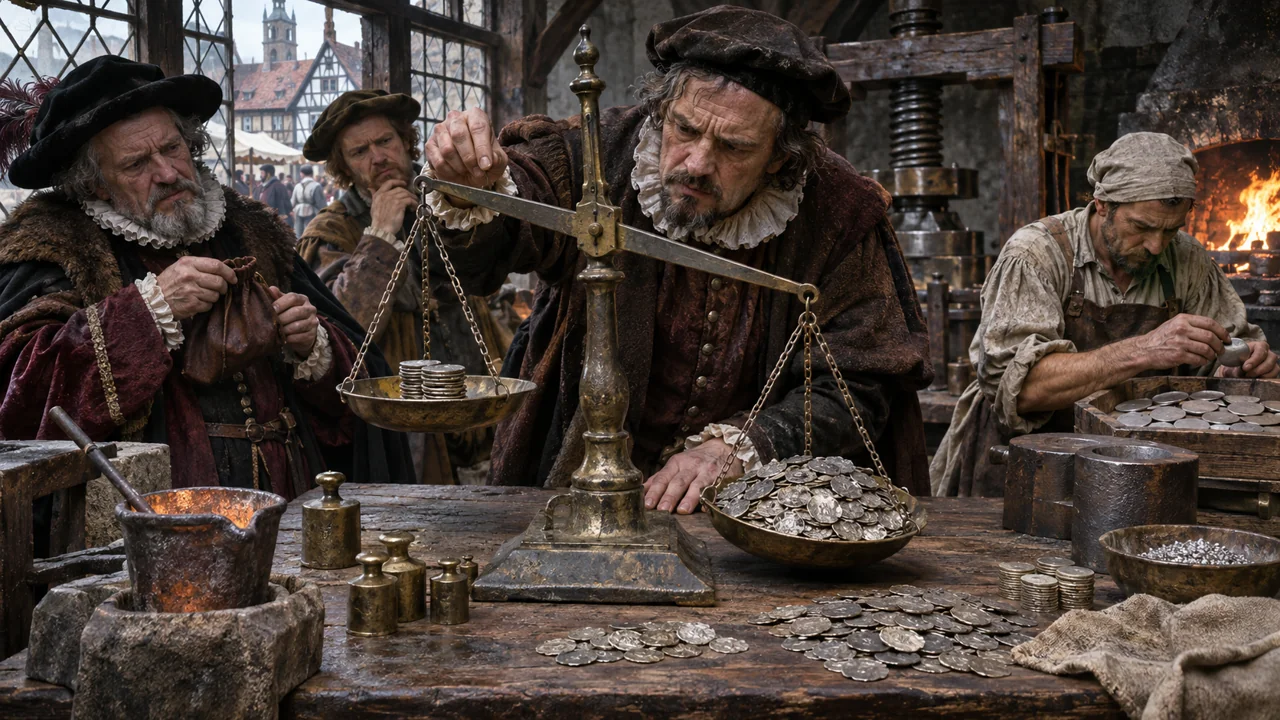
The name comes from the tools of the trade. Kippen means to tip, wippen to see-saw: on their scales the changers picked out the coins heavy enough to tip the beam and pulled them from circulation, keeping the pan moving to fool the eye. Gresham's law was in full force: bad money stayed in people's hands, good money ended in the melting pot.
Inflation starts with small change
The episode first shows who bears a debasement. Wages, bread and small debts were settled in kreuzer, so the loss fell on those who lived on small change, while the issuer pocketed the gap between face value and metal, the seigniorage. The gain then turned against the princes: taxes came in as copper coins, mercenaries demanded sound money and peasants stopped bringing their produce to market.
It then shows the cost of a currency without common discipline. Each issuer gained by cheating as long as the loss spread to its neighbours; once all of them cheated, all of them lost. The way out came not from a more virtuous prince but from a concerted return to the Imperial Mint Ordinance of 1559: in 1623 the Reichstaler went back to 90 kreuzer, a rate that held for some forty years. The lesson still speaks to monetary unions, whose shared currency holds only if no member funds itself at the others' expense.
A currency rarely decays all at once: it first grows lighter in the pockets no one watches.