The Monday Wall Street
lost a fifth
On Monday 19 October 1987 the Dow Jones lost 508 points, or 22.6%, in a single session: the worst one-day fall in its history. No war, no spectacular bankruptcy explains it, and exchanges around the world followed.
Five hundred and eight points in one session
Through the summer of 1987 Wall Street had piled up record highs. By mid-October a larger-than-expected US trade deficit and a weak dollar were shaking confidence, and prices slid through the week. On Friday 16 October the Dow Jones closed at 2,246.74. On Monday the 19th it ended at 1,738.74: 508 points lower, 22.6% of its value. The S&P 500 fell 20.5%.
The first suspects were not events but mechanisms. Many institutional investors were then practising “portfolio insurance”: a technique of selling index futures as prices fall, in order to limit losses. Taken alone, the protection is rational. Applied by many players at once, it turns every dip into a fresh wave of automatic selling, while buyers thin out and order-routing systems jam.
The crash did not stay American. Over October alone, the Hong Kong market lost nearly 46%, those of Australia and Singapore more than 40%. The next day Alan Greenspan, chairman of the Federal Reserve for two months, issued a one-sentence statement: the central bank stood ready to serve as a source of liquidity to the economic and financial system. Within two sessions the Dow Jones regained 288 points, a little over half of the loss.
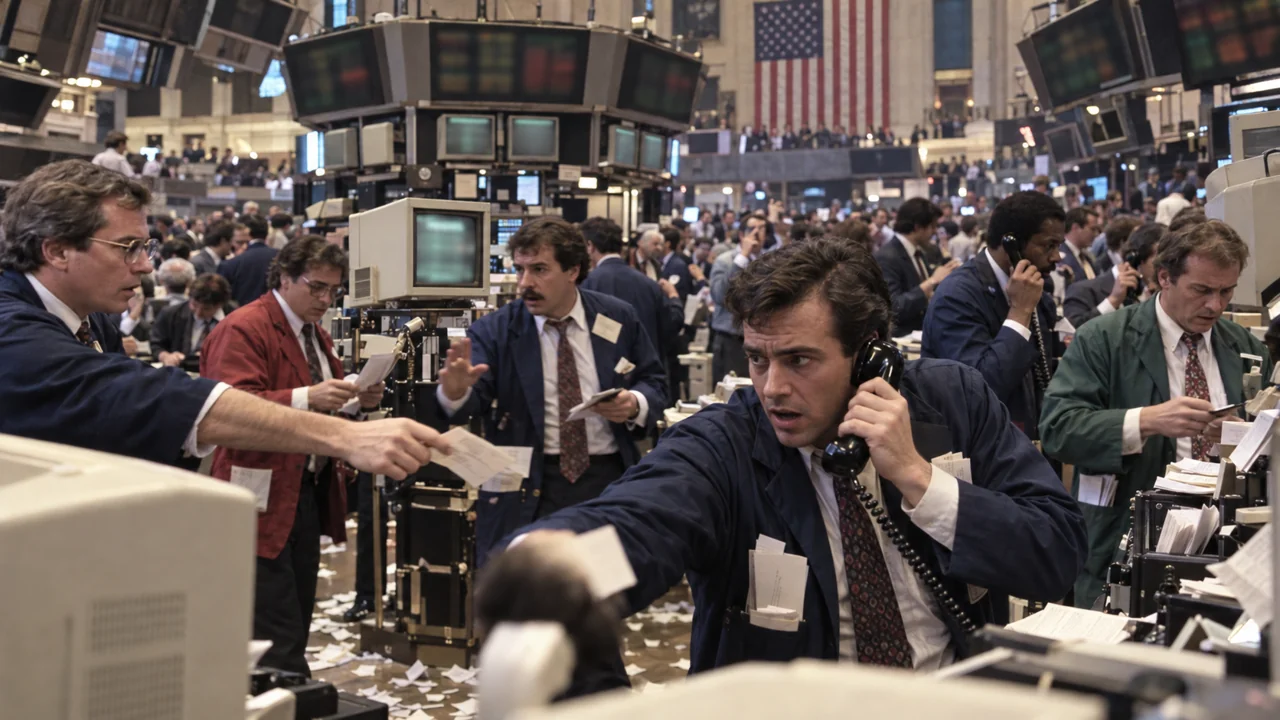
When everyone's prudence becomes everyone's risk
The lesson goes beyond the anecdote. Nothing justified, that day, a fifth of stock-market value evaporating in six and a half hours of trading: the US economy did not tip into recession, and the index regained its pre-crash level in under two years. What broke was not wealth but liquidity, the market's capacity to absorb sell orders without the price collapsing.
The presidential commission set up to investigate, known as the Brady Commission, delivered its report in January 1988 and pointed to poorly coordinated stock, futures and options markets. Exchanges then introduced circuit breakers, automatic trading halts triggered by a fall that is too fast, which survive today in finer forms. The episode remains a reference in debates on algorithmic trading: an individual protection strategy can, once shared, manufacture the very risk it claims to remove.
A market does not always collapse from having hoped too much; sometimes it is because too many people decided, at the same moment, to protect themselves in the same way.