The king who made
gold cheap in Cairo
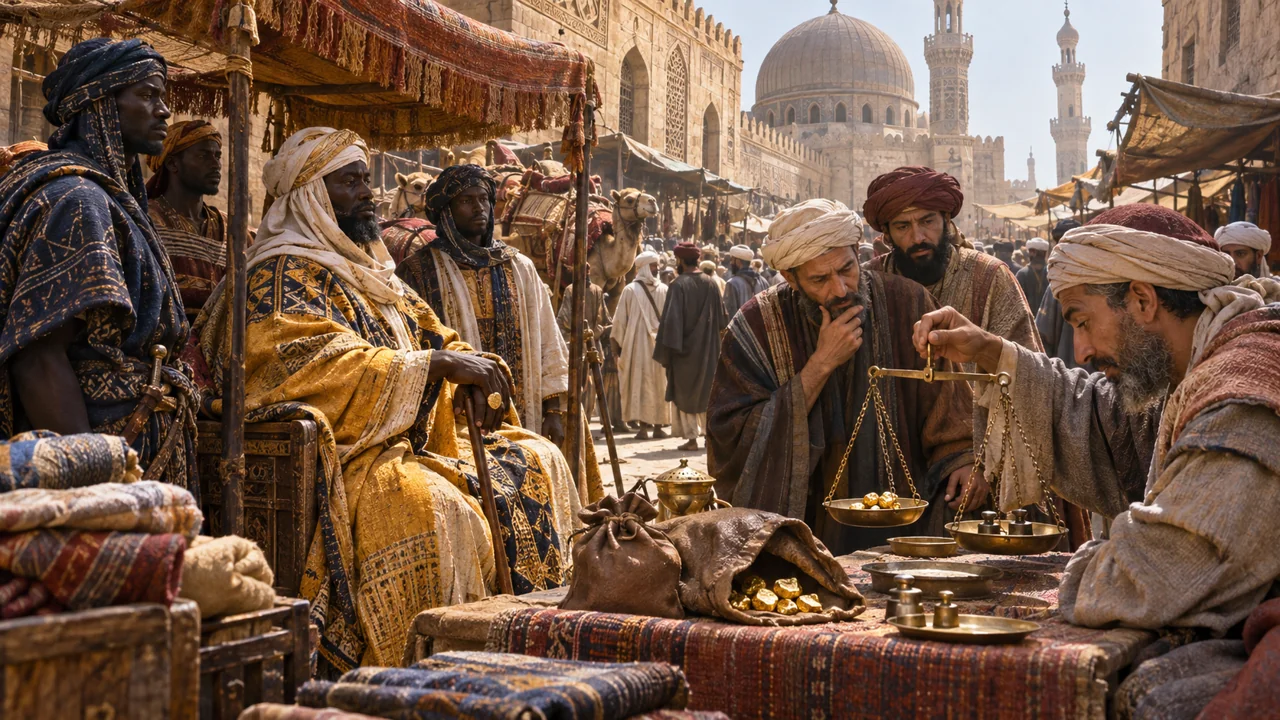
In the summer of 1324, Mansa Musa, ruler of Mali, stopped in Cairo on his way to Mecca. He spread so much gold there that, according to a contemporary witness, the metal was still worth less a dozen years later.
A pilgrim who paid in gold
In the early fourteenth century the Mali empire controlled a large share of West African gold, mined in the Bambuk and Bure fields and carried across the Sahara. When Mansa Musa set out on pilgrimage to Mecca, he took enough to pay for every stage. In Cairo, capital of the Mamluk sultanate, he was received by Sultan al-Nasir Muhammad and showered gifts: loads of unworked gold sent to the royal treasury, presents for every court emir and every holder of office, generous payments in the markets.
The most reliable account comes from Ibn Fadl Allah al-Umari, a scholar of the Mamluk chancery, who gathered in Cairo the testimony of people who had met the king. In his encyclopedia, the Masalik al-absar, he notes that the Cairenes exchanged so much gold that they depressed its value. Chroniclers also report that on the way home, short of funds, Musa had to borrow from the city's merchants.
The figure that matters is modest and precise. Before the king came, al-Umari writes, the mithqal of gold (about 4.25 grams) never fell below 25 silver dirhams; a dozen years later it fetched 22 or less. That is a fall of at least 12% in the price of gold in terms of silver, and a lasting one. The caravans of sixty thousand people and the tonnes of gold often quoted come from later, unverifiable sources.
A supply shock on a single metal
Cairo ran on a bimetallic system: the gold dinar and the silver dirham circulated side by side, and their ratio moved with each new supply. A sudden inflow of one metal was enough to shift it. What al-Umari describes is less a general inflation than a change in relative price: once more plentiful than silver, gold cost less in silver. The quantity of money matters, but so does the stuff it is made of.
On a small scale, the episode foreshadows the sixteenth-century “price revolution”, when American silver from Potosí pushed up European prices, and it illustrates a rule central banks know well: sudden money creation shows first in the price of whatever it floods. It also counsels caution before the legend. On the Catalan Atlas of 1375, Musa still sits enthroned with a nugget in hand; memory enlarged the gesture, while the closest witness measured its effect at three dirhams.
Wealth spread too fast always ends up recalling what scarcity is worth.