Portuguese wine
for English cloth
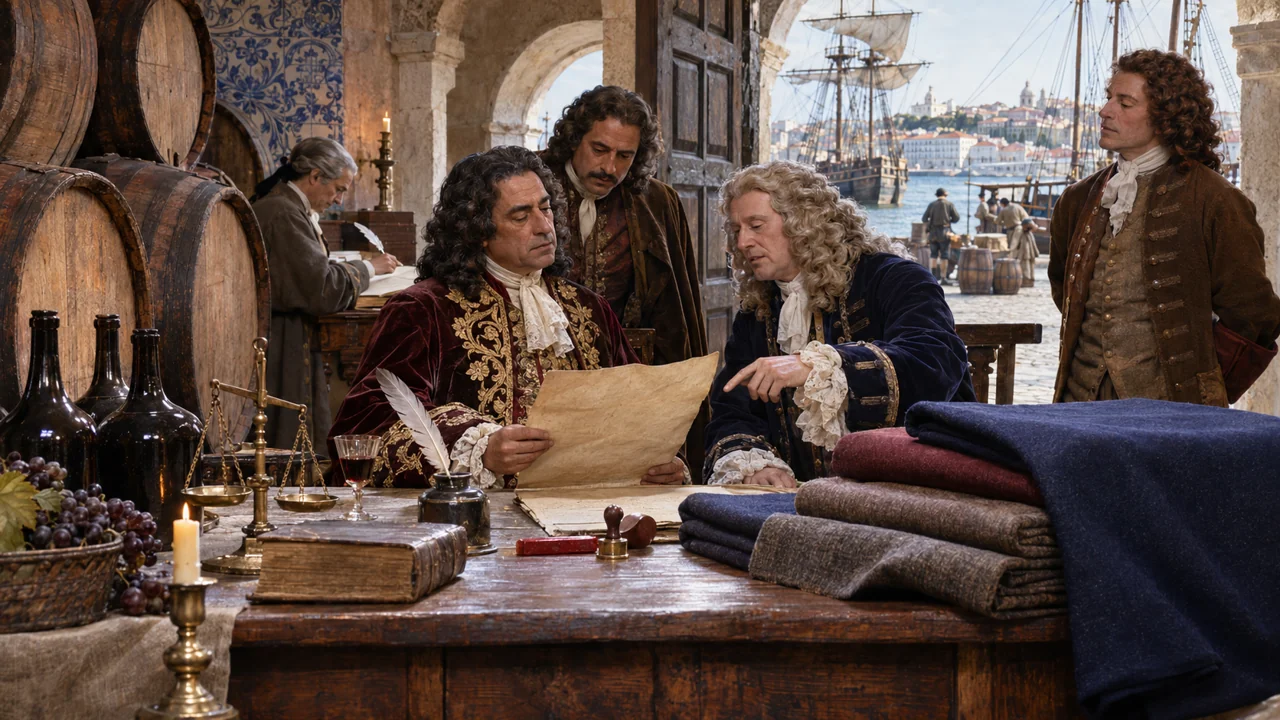
On 27 December 1703, England and Portugal concluded a commercial treaty with very simple terms: English woollen cloth entered Portugal, and Portuguese wines paid a third less duty in England than French wines. A century later, this exchange would become the most famous example in economics.
A trade deal born of a war
In 1703 Europe had entered the War of the Spanish Succession. In May, the English envoy John Methuen, posted in Lisbon, had already brought Portugal into the Grand Alliance against Louis XIV's France. On 27 December he concluded with the Marquis of Alegrete, Manuel Teles da Silva, a second treaty, this time commercial, which would keep his name.
The commitments were mutual. Portugal opened its market to English woollens; in return, England undertook never to tax Portuguese wines at more than two thirds of the duty on French wines. With France an enemy and Bordeaux claret hard to come by, port found a lasting outlet in England, one that would long shape British taste and the economy of the Douro valley.
Adam Smith, in The Wealth of Nations in 1776, judged the deal advantageous to Portugal and disadvantageous to Great Britain: London granted a real tax preference to a wine, while Lisbon merely let in cloth it was already buying. Portuguese opinion would later reach exactly the opposite verdict.
From a trading post to a textbook
In 1817 David Ricardo took up the pair in his Principles of Political Economy and Taxation. In his example, England needs the labour of 100 men for a year to produce a given quantity of cloth, and 120 for a quantity of wine; Portugal needs 90 and 80. Portugal is more efficient at both, and yet both countries gain by specialising: each produces what it does relatively best and buys the rest. Comparative advantage was born.
Real history tempers the elegance of the model. As early as the eighteenth century, Portuguese critics, among them the diplomat Luís da Cunha, blamed the treaty for holding back the national cloth industry and binding the country to the English market. The question has not aged: does specialisation enrich both partners equally, or does it freeze unequal roles? It returns whenever free-trade agreements or industrial sovereignty are debated.
It took a century for a bottle of port to become a lesson in economics.