The bank secured
by pastures
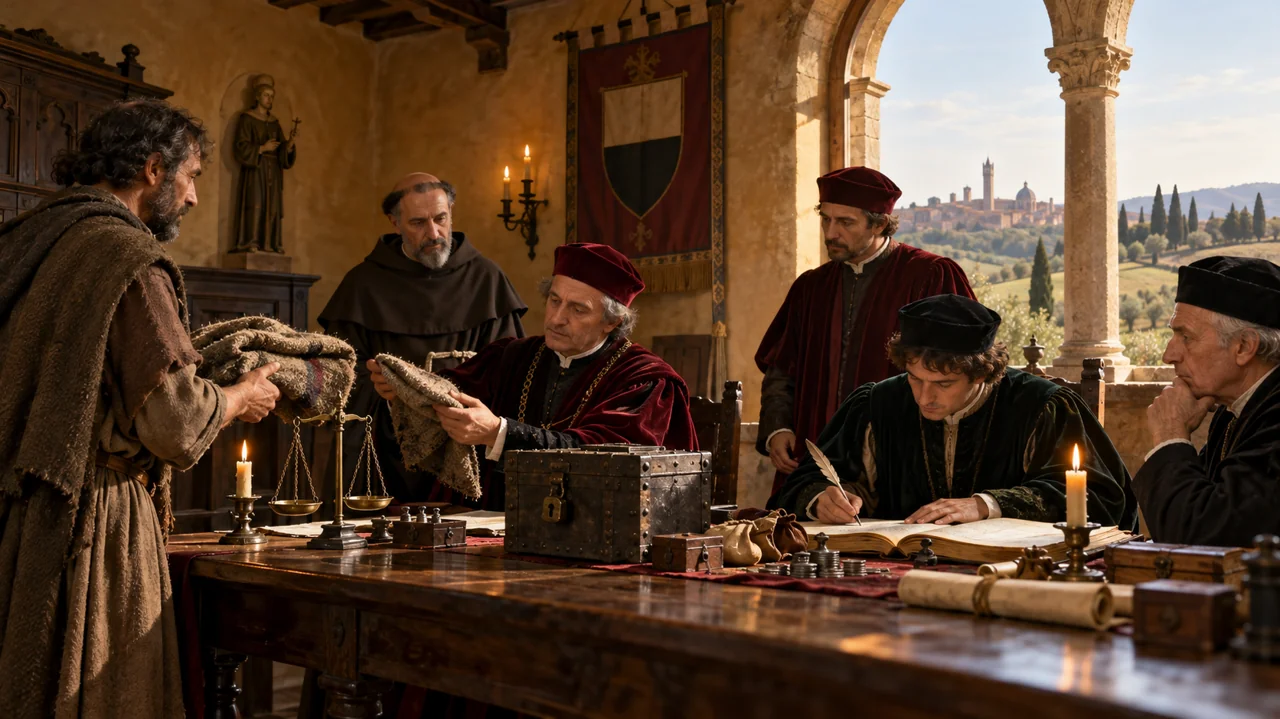
On 4 March 1472 the magistrates of the Republic of Siena approved the statutes of a pawn-lending house meant to hold usury in check. More than five centuries later it still exists as Monte dei Paschi, the "mountain of the pastures", and its name still carries the collateral on which it was refounded.
From pawn loans to credit secured by land
In 1472 Siena was a merchant republic where inequality was widening and borrowers depended on private lenders. On 4 March its magistrates approved the statutes of a monte di pietà, a charitable pawn-lending house of the kind the Franciscans encouraged across Italy. Its purpose was narrow: to advance money against goods deposited, on terms ordinary usury would not grant.
The turning point came in 1624. Siena had been absorbed into the Grand Duchy of Tuscany, and Grand Duke Ferdinand II refounded the establishment: the revenues of the state pastures of the Maremma, the paschi, were pledged as security for deposits. The Monte dei Paschi was constituted on 2 November 1624. A depositor no longer entrusted his money to a promise, but to an income drawn from the land.
The name says it all. The "monte" is a fund of capital; the "pastures" are its collateral. Where a modern bank rests on its own capital and its reputation, this one rested on public agricultural revenue that depositors could regard as something tangible.
A guarantee is not an insurance policy
Securing the bank on land answered the problem of every young bank: convincing the depositor that he will get his money back. The guarantee only has to be visible, lasting, and out of reach of one debtor's whims. The same logic returns in another form with the German rentenmark of 1923, itself backed by land.
Longevity, however, does not protect against error. From January 2013, the disclosure of concealed derivatives transactions, known as Santorini and Alexandria, set off a crisis that peaked in July 2017: the Italian state recapitalised the bank with 8.1 billion euros, of which 3.9 billion was subscribed by the Treasury, the rest coming from the forced conversion of bonds into shares. The bank often described as the oldest still operating had to be rescued by the public authorities. Five centuries of history did not stand in for a sound balance sheet. Yesterday's collateral, an agricultural income, has given way to a guarantee the state provides as a last resort: who bears a bank's risk remains, five centuries later, an open question.
A bank is born of a collateral and survives only on honest accounts.