The island that
exported its soil
In 1968 Nauru became the smallest republic in the world and inherited a singular treasure: the island's own ground. It is made of phosphate, the fertiliser world agriculture clamours for, and it would make its people one of the richest on the planet before running out.
A rich people on a ground running out
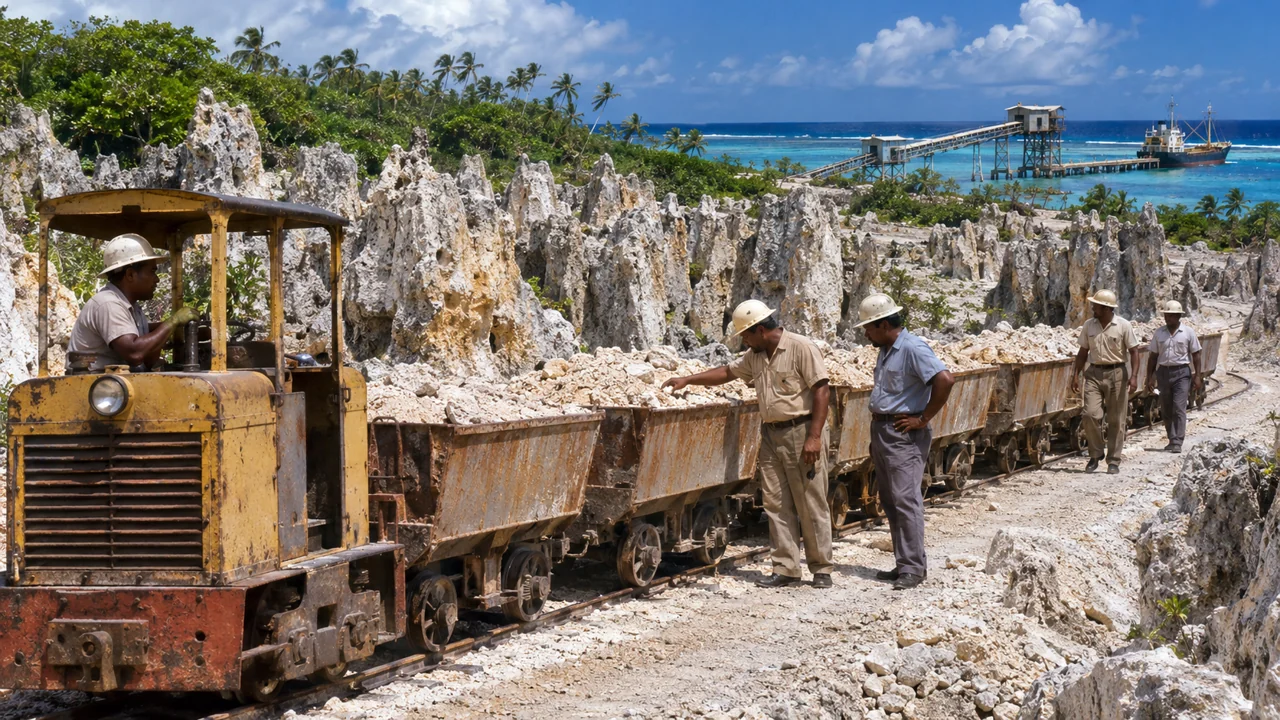
Around 1900, a rock first mistaken for petrified wood proved to be phosphate of the highest grade. In 1906 the Pacific Phosphate Company obtained the mining rights, and the island became an open-pit mine under British, Australian and New Zealand administration. The Nauruans themselves saw little of it: in 1948, out of A$745,000 in revenue, about A$15,000, or 2%, came back to them.
Independence changed everything. In 1970 the new state bought the phosphate rights from Australia for A$21 million. Revenue then ran at A$100 to 120 million a year, much of it placed in a trust, the Nauru Phosphate Royalties Trust. Around 1975, wealth per head was estimated at some $50,000, second in the world behind Saudi Arabia, according to the economist Helen Hughes.
The trust was meant to make the fortune outlast the ore. It reached about A$1.3 billion around 1990, then collapsed to some A$300 million by 2004, through overseas property, an airline and borrowing. Nauru House in Melbourne was sold in 2004 to repay a General Electric Capital loan; Air Nauru's only aircraft was seized in December 2005.
A rent is not a lasting income
Ore torn from the ground does not renew itself: what Nauru collected was not income but the slow liquidation of a capital, in the literal sense, since the island itself was vanishing under the excavations. The right question was not how much was coming in, but how much was being turned into lasting assets before the mine closed.
Economists speak of the resource curse: a sudden windfall tends to push spending up, discourage other activities and steer money toward poorly controlled investments. Nauru is a textbook case, and a useful reminder for sovereign funds today: the withdrawal rule, diversification and governance matter more than the initial sum. Since then the island has found other resources, including hosting an asylum-processing centre for Australia, which the government estimated at about 58% of its revenue in 2019-20.
What is left of a fortune when there is nothing left to extract?