The house
they refused to save
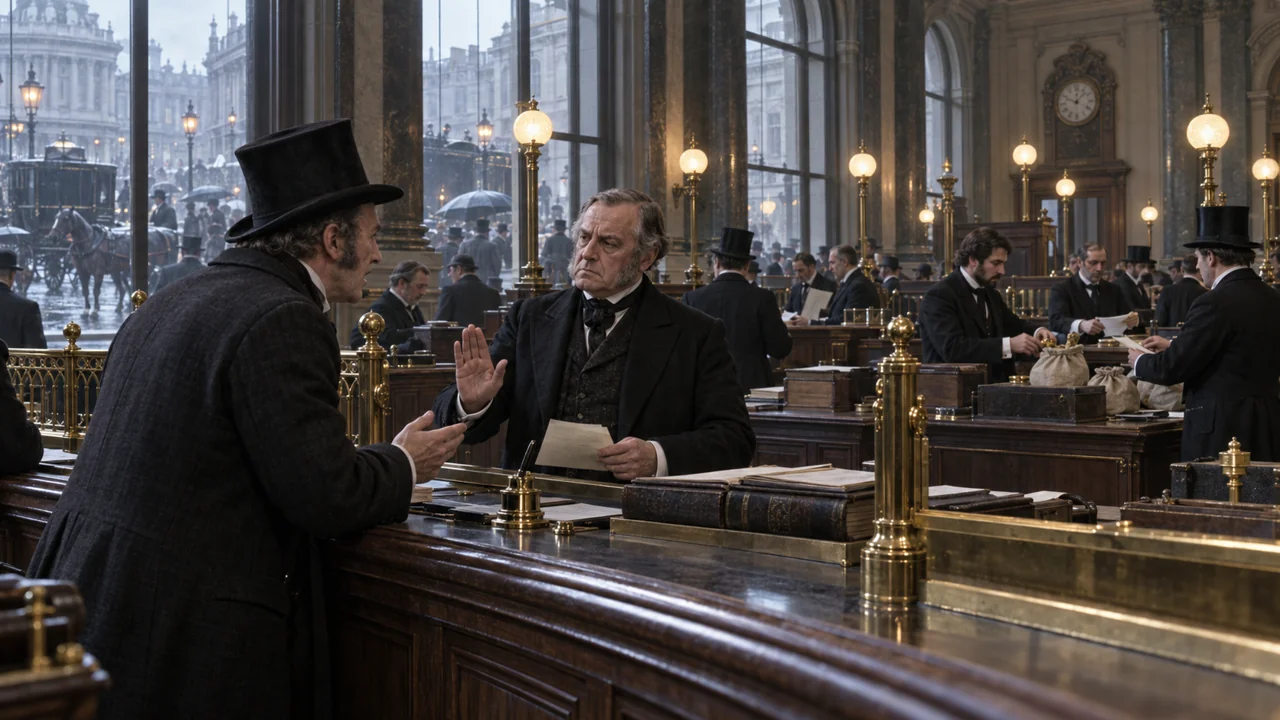
At half past three on 10 May 1866, the largest discount house in London posted on its door that it was suspending payment. The Bank of England had just refused it any assistance. The next day the City lived through its "Black Friday", and the government suspended the law that capped the issue of banknotes.
A house turned away at the door
Overend, Gurney & Co. was no ordinary house. Founded in 1807 by Samuel Gurney, it dealt in bills of exchange, the instrument that settled almost all commerce at the time. By the 1850s its deposits matched those of its three competitors combined, and the bills passing through it each year were worth about half the British national debt. From 1859, however, a new generation of partners pushed it into long-term lending: plantations, grain, ironworks, shipping, railways. The files were barely examined.
In July 1865 the house turned itself into a limited liability company and placed one hundred thousand shares of fifty pounds. Its partners already knew it was insolvent by four to five million pounds, on a balance sheet of some twenty million. The spring of 1866 did the rest: fear of war in central Europe, falling prices, failures in series. On 9 May a court ruled that Overend Gurney could not recover its debt from the Mid-Wales Railway; the run began. That same day the partners asked the Bank of England for help. The Bank sent a committee into their books and refused: the house was insolvent, not illiquid.
The trap lay in the share itself. Of the fifty pounds on each one, only fifteen had been called; the other thirty-five remained payable on the company's demand. The liquidation called them. Those who had paid fifteen pounds had to hand over twenty-five more, then lost the case they brought against the partners.
The rule born of a refusal
The refusal was not abandonment. The Bank shut its door on one insolvent house and opened it to all the others. Between Thursday 10 and Saturday 12 May its outright purchases of bills tripled and its repurchase discounts rose by a third; it funded that support by emptying its own till, whose share of the balance sheet fell from 16% to 2% in three days. On 11 May Chancellor Gladstone suspended the 1844 Bank Charter Act, which tied notes to gold, on a single condition: that the discount rate be raised to 10%. The Bank never had to issue a single uncovered note. The announcement had been enough.
Seven years later Bagehot drew from those days the doctrine of the lender of last resort: in a panic, lend freely, at a high rate, against collateral that would be good in ordinary times, and to whoever can provide it. Everything rests on the line drawn on 9 May between the illiquid institution, which is rescued, and the insolvent one, which is let go. Every central bank still claims that line. It is easier to state than to place when you have one night to read a set of books.
A central bank is defined as much by what it lends as by what it refuses to lend.