The canal that opened
without a party
On August 15, 1914, the Panama Canal opens to commercial shipping: the cargo ship Ancon makes its first official transit, with no head of state and no fanfare. Seven weeks earlier, the assassination of Archduke Franz Ferdinand had set Europe on the road to war; the international ceremony planned for the opening is simply called off.
Ten years of building, not a day of celebration
Since 1904 the United States had taken over a project France had abandoned fifteen years earlier, ruined and bereaved by yellow fever and malaria. The American works employed up to 56,000 workers between 1904 and 1913; around 5,600 deaths are recorded over that period, a figure historians consider well below the truth, for lack of a systematic register on the French side. The bill comes to roughly $375 million, including $10 million paid to Panama and $40 million paid to France for its abandoned assets.
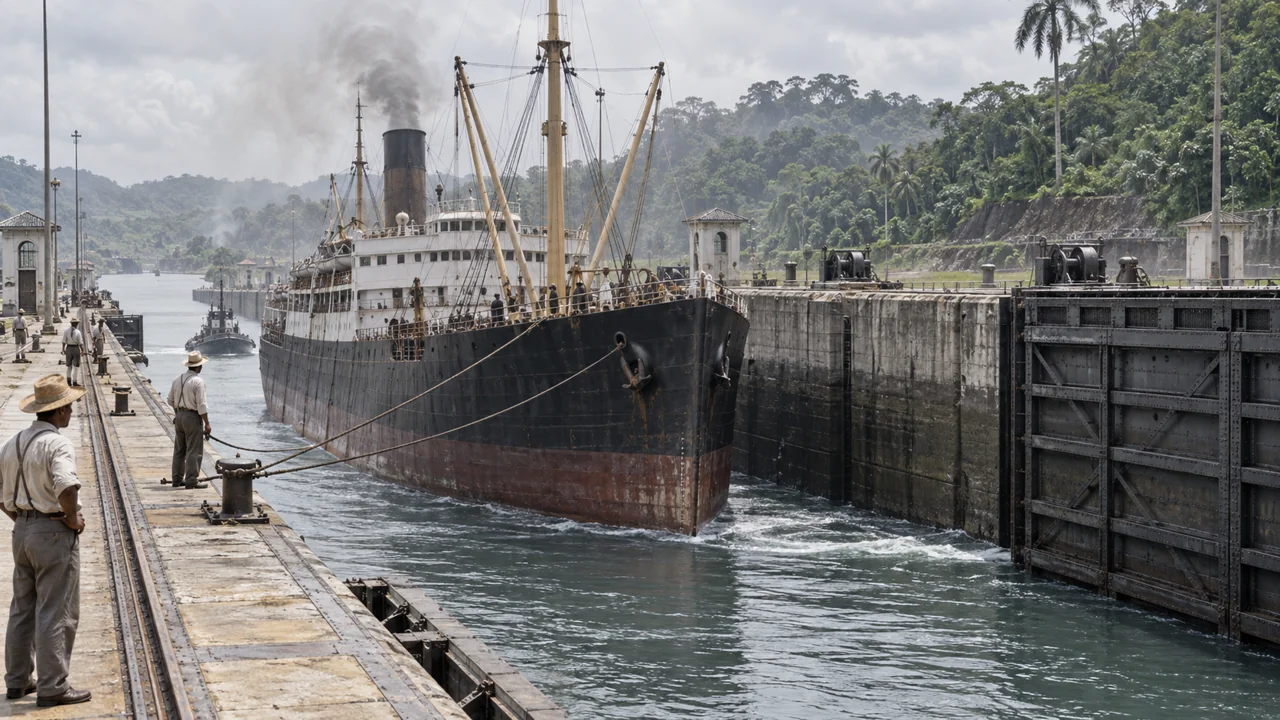
On August 15, 1914, the cargo ship Ancon leaves Cristobal, on the Atlantic side, and reaches Balboa, on the Pacific, after a crossing of about nine hours. No crowned head, no dignitary aboard: the international ceremony Washington had been preparing for months, with foreign fleets due to attend, is called off the moment Europe goes to war. A witness of the time would later note that a stranger arriving by chance that day would have thought the canal had always been open.
Technically, the canal does not simply cut a channel at sea level: three pairs of locks lift each ship 26 meters above the oceans, into the artificial Gatun Lake, before lowering it back down on the other side. It is this system, not a mere trench, that took ten years to build; on August 15, 1914, it works on the first try.
The shortcut that changes the price of the world
What the opening lacks in splendor, it makes up for in reach: a voyage between New York and San Francisco, which required more than 13,000 nautical miles around Cape Horn, is cut to just over 5,000 miles through the canal, nearly 8,000 miles saved on every trip, without a single ship sailing any faster. World freight has just gained what no trade negotiation could have offered it: time and distance, sliced at a stroke off the map of commerce.
The episode says something economic history often repeats: an infrastructure produces its effect regardless of the noise, or silence, that surrounds its opening. The Panama Canal never stopped shaping world trade once the party was forgotten; more than a century later, it remains one of the most closely watched choke points on the globe, so sensitive to its own natural conditions that the slightest shift in rainfall is felt at once in the price of freight.
A route can redraw the world without a single head of state cutting its ribbon.