The Tuesday New York
ran out of money
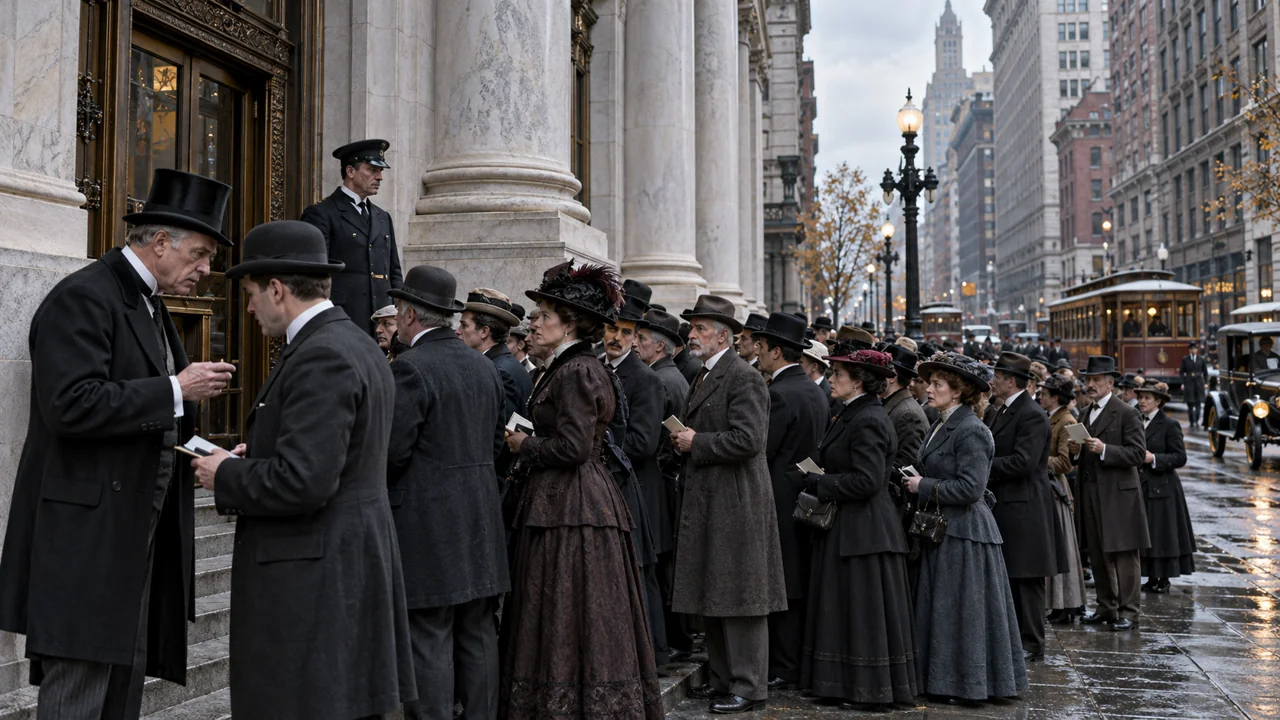
On 22 October 1907, the Knickerbocker Trust Company, one of Manhattan's great institutions, suspends payments after nearly $8 million is withdrawn. No public authority could then create money in an emergency. A private banker did it instead.
A run on banks that were not banks
It begins on 16 October 1907 with a failed bet: Augustus Heinze and Charles Morse fail to corner the stock of United Copper. Both speculators ran banks, and rumor spreads to their institutions, then to all those believed to be tied to them. The New York Clearing House contains the fire among its member banks. But the trusts, fiduciary companies that took deposits without belonging to its circle, remain exposed.
On 21 October the Knickerbocker's board ousts its president, Charles Barney, who is linked to Morse, and the Clearing House refuses to rescue it, its resources being reserved for members. John Pierpont Morgan, whose team led by Benjamin Strong has no time to establish the trust's solvency, also refuses to lend. On the 22nd the Knickerbocker closes. The same day the overnight money rate jumps from 9.5% to 70%, then reaches 100% two days later.
The trusts prove more fragile than anyone had measured: they kept about 5% of their deposits in cash, against about 25% for national banks. Between 22 August and 19 December 1907, more than 36% of New York trust deposits leave, while those of national banks rise. The Trust Company of America suffers the fiercest run.
Morgan then gathers cash from the large institutions and sends it to the New York Stock Exchange's loan post, so that brokers keep lending and the market stays open. On 26 October the Clearing House arranges the issue of loan certificates, and the banks restrict the conversion of deposits into cash.
A lender of last resort that did not exist
The Panic of 1907 poses a question the United States had not settled: who creates liquidity when everyone wants their money back on the same day? With no central bank, a private banker, together with the Clearing House, improvises the answer. The loan certificates foreshadow, in miniature, the discount window of the future Federal Reserve. The cost was real: industrial output falls 17% in 1908 and real national product 12%.
Congress draws the lesson: the Federal Reserve Act is signed in December 1913, and the twelve Reserve Banks open about a year later. The core of the episode has not aged. An institution can be solvent and still fall for want of liquidity; crisis breaks out where reserves are thin and the safety net does not reach. Historians at the Federal Reserve Bank of New York in fact compare the Knickerbocker's fall to that of Lehman Brothers in 2008.
When everyone wants their money on the same day, solvency is not enough: someone has to lend.