The day oil was worth
less than nothing
On 20 April 2020 the American benchmark barrel settled at minus $37.63. Not almost nothing: less than nothing. Holders now had to pay to be rid of oil that nobody knew where to put.
A barrel you paid someone to take
In the spring of 2020 lockdowns grounded planes, trucks and cars. Production, however, does not stop overnight. The surplus piled up and had to go somewhere. Yet the futures contract on American crude, West Texas Intermediate, is not an abstract wager: at expiry, whoever holds it must take delivery of a thousand physical barrels at Cushing, Oklahoma, a pipeline crossroads whose tanks were by then nearly full.
On 20 April, the day before the May contract expired, the last holders tried to get out; on the other side, no one wanted a delivery they could not store. The price went below zero in the afternoon, touched minus $40.32 and settled at minus $37.63 a barrel, a first since the contract was launched in 1983. Five days earlier the CME clearing house had warned that its systems would accept negative prices. Few people read that as a warning.
A negative price is not an accounting anomaly. It signals that a good has become a burden: storing it, moving it or disposing of it costs more than the thing is worth. Oil had not lost its usefulness; what it lost that day was somewhere to wait.
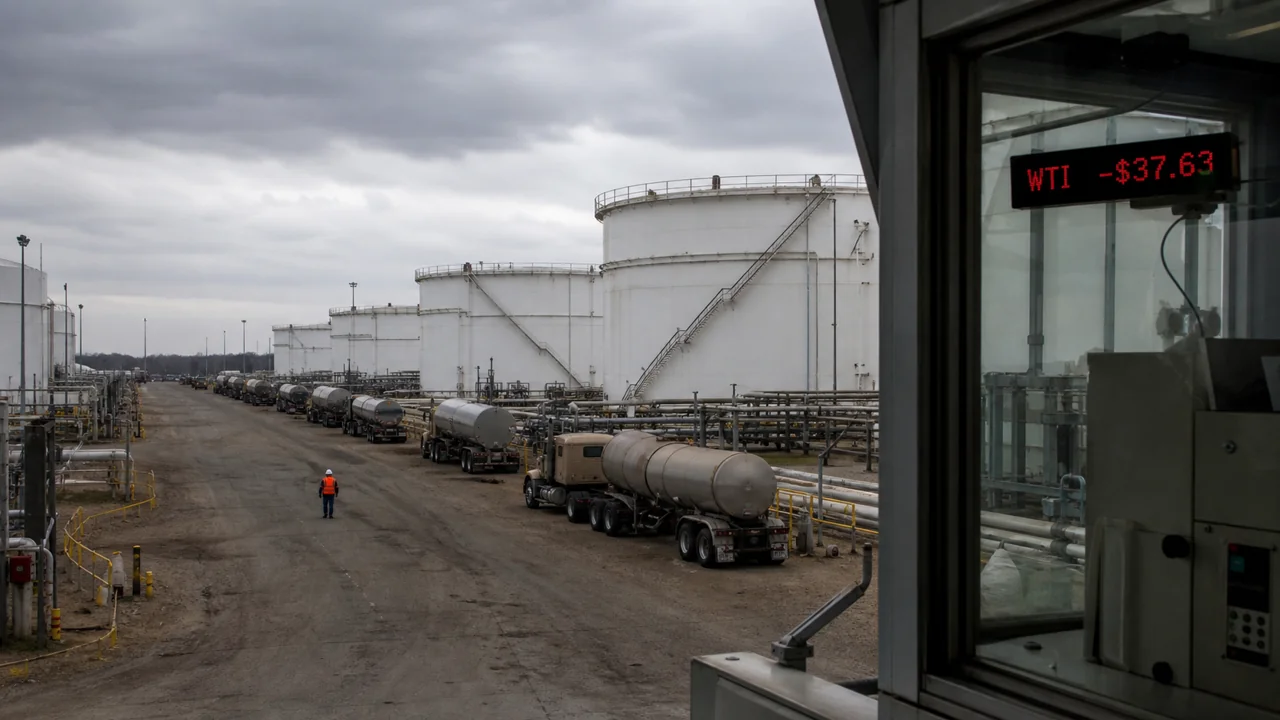
No price exists without a place to hold the thing
The episode is a reminder of what finance readily forgets: behind a contract there is a tank. As long as storage is plentiful, the futures price behaves like a number; when it runs short, the physical constraint takes back control. Oil was the first large listed asset to show this so brutally, but the same logic governs electricity, whose prices regularly fall below zero when output exceeds demand and the grid has nowhere left to send it.
The lesson was expensive for those who thought they were buying oil by buying a contract. In China, holders of a savings product tied to that May expiry, Bank of China's Yuan You Bao, lost something in the order of ten billion yuan, and some ended up owing money to their bank. Holding a commodity derivative is not owning the commodity: it is inheriting, at expiry, its constraints.
There is no value outside the physical world: you always need somewhere to put what you own.