The Rentenmark,
a currency backed by land
On 15 November 1923, Germany put the Rentenmark into circulation, a currency without gold, backed by the country's land and businesses. A single Rentenmark was worth a trillion paper marks, and the surge in prices stopped within weeks.
A currency without gold, resting on land
By autumn 1923 the mark was no more than paper to be spent before it lost its value. Since the occupation of the Ruhr in January, the German state had been financing its deficits by running the printing presses, and prices multiplied from one day to the next. Savers watched their savings melt away, while debtors paid off their debts for next to nothing. A new currency was needed, but the country did not have enough gold to guarantee one. The idea adopted, advanced notably by Karl Helfferich and taken up in Finance Minister Hans Luther's plan, was to back the currency not with a metal but with real assets.
In mid-October the government created the Deutsche Rentenbank. Farmland, industry and trade were encumbered with a global mortgage of 3.2 billion Rentenmarks, and on that pledge the bank issued, from 15 November, notes in strictly limited quantity. Hjalmar Schacht, appointed currency commissioner on 12 November, settled the exchange question.
On 20 November the parity was fixed: one Rentenmark was worth a trillion paper marks, and one dollar bought 4.2 Rentenmarks, the pre-war rate. That day the dollar was therefore worth some 4,200 billion paper marks: twelve zeros wiped away at a stroke.
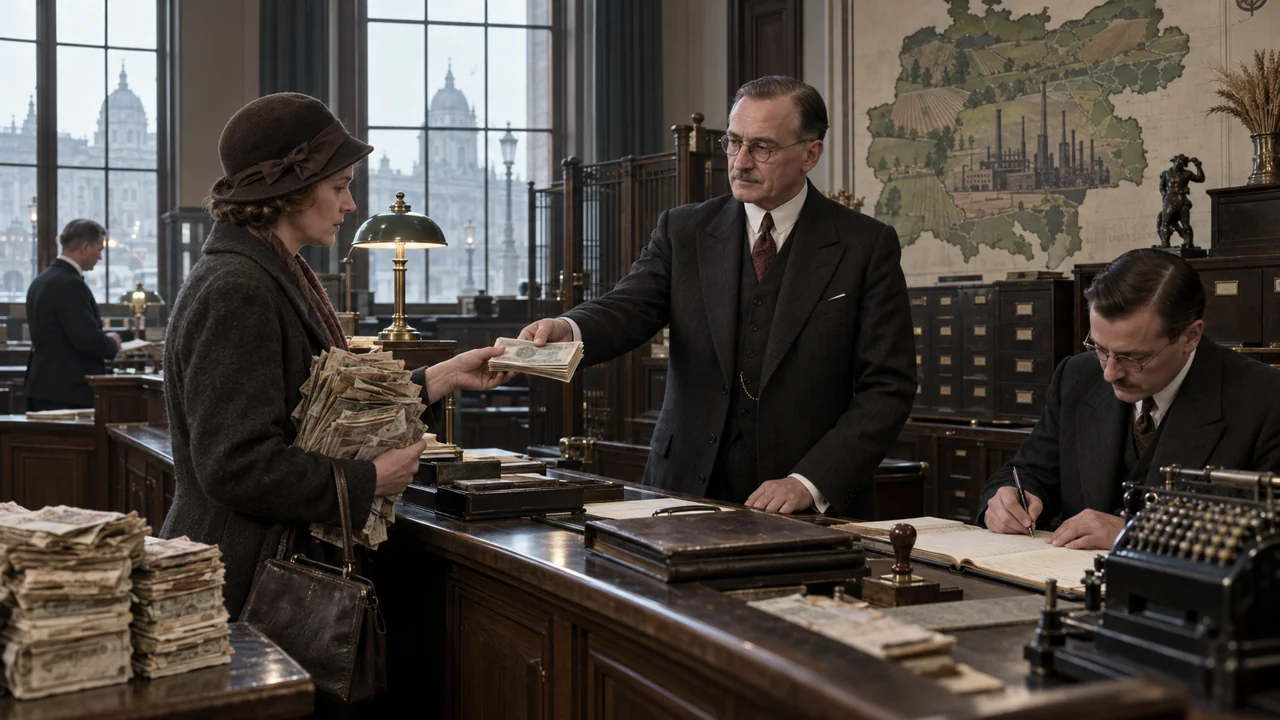
Confidence is born of a limit
The land pledge mattered above all as a signal: what restored confidence was the limit placed on issuance. In the following months Hans Luther and Hjalmar Schacht restricted the money supply and imposed deep budget cuts, so that the state stopped financing its deficits with the printing press. People would soon speak of the "miracle of the Rentenmark."
The Rentenmark was, in any case, a transitional currency: on 30 August 1924, under the Dawes Plan, the Reichsmark, backed by gold and foreign currencies, succeeded it at par, while Rentenmark notes stayed valid until 1948. The episode sheds light on present-day debates about what anchors a currency, from gold to stablecoins: what secures money depends less on the object that backs it than on the rule that bounds its quantity. The lesson holds for more recent crises, such as Zimbabwe's, where the currency kept losing all meaning as long as issuance stayed unchecked.
A currency recovers the day it stops promising more than it can keep.