The saloon that invented
the cash register
On 4 November 1879, two brothers from Dayton, Ohio, filed a patent for a "cash register and indicator." Their aim was not technological: they wanted to know, at closing time, whether the staff of their saloon had put all the money they took into the drawer.
A propeller counter behind the bar
James Ritty had run a saloon in Dayton since 1871. He suspected his employees of keeping part of the takings, and he had reason to doubt: at the time nothing separated money received from money in the drawer, and only the person serving knew what had really been paid. In 1878, on a steamship crossing to Europe, he watched a mechanism that counted the turns of the propeller. It occurred to him to do the same with sales.
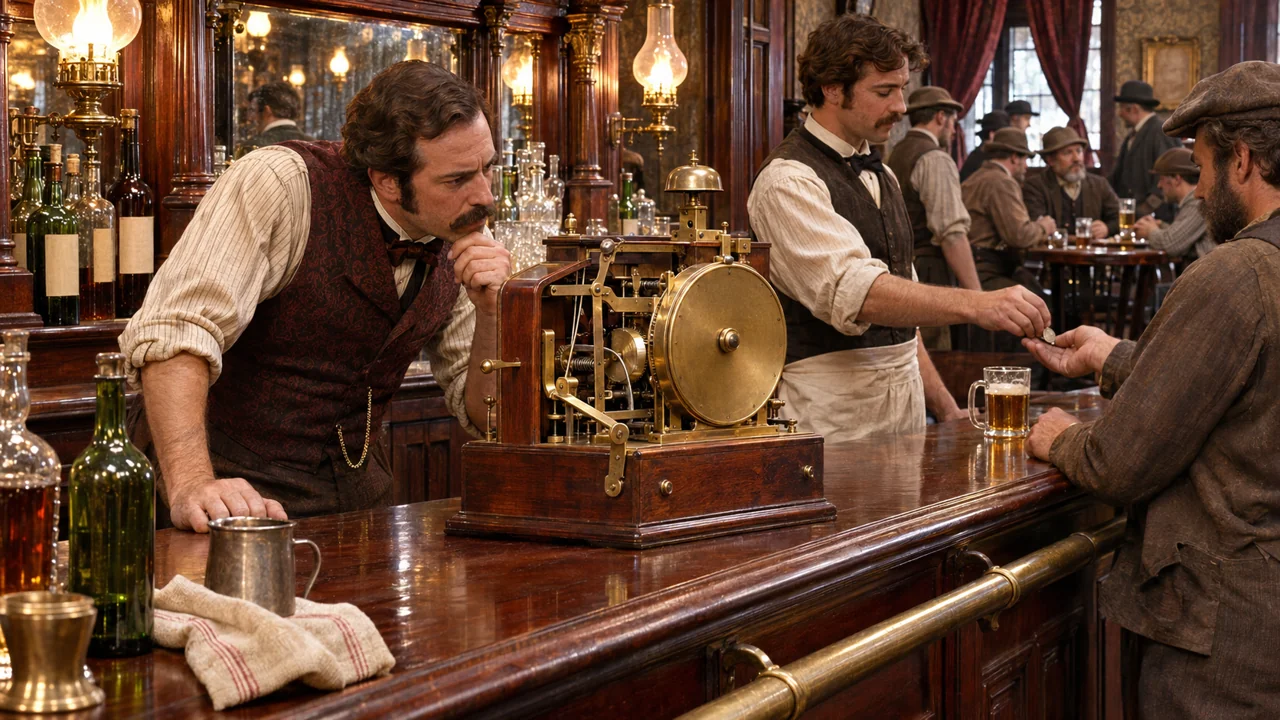
With his brother John, a mechanic, he built a dial machine he called the "Incorruptible Cashier." Each sale was recorded by pressing a key: the total appeared on a dial visible to all and a bell rang. The owner heard every transaction, the customer saw the amount. The patent, titled "Cash Register and Indicator," was filed on 4 November 1879.
The genius of the device lay less in its mechanics than in its staging. The bell and the dial made the sale public: an employee who wanted to pocket a payment had to do so in front of witnesses, and leave a trace the owner would compare with the drawer. The first models printed no receipt; the paper roll, which would give the cash journal and the ticket, came later.
Busy with two businesses at once, Ritty sold his rights in 1881 to a group of Cincinnati investors led by Jacob Eckert, who founded the National Manufacturing Company. In 1884 John H. Patterson took over the firm and renamed it National Cash Register, the future NCR.
Verifying rather than trusting
The cash register was first of all an internal control tool. It answered an old problem, that of the owner who cannot watch at every moment the person handling his money. By producing a record independent of the employee's word, it replaces trust with verification, and lets you leave a counter in someone else's hands. That is a condition of growth for any shop: an owner who can no longer see everything can no longer expand.
The receipt, real-time bookkeeping and today's point-of-sale terminal extend that gesture. Every recorded line is a piece of evidence, and the worth of evidence is that it cannot be rewritten afterwards. One question remains open in the age of digital exchange: who plays the incorruptible cashier for transactions that nobody sees go by?
What you cannot watch, you must learn to record.