The shop that paid
its profits back to customers
On 21 December 1844, in a lane in Rochdale near Manchester, a small grocery shop opened its doors a few evenings a week. Nothing set it apart from the others except one rule: part of what the shop earned went back to the people who bought from it.
A shop built up penny by penny
In 1844 twenty-eight working men of Rochdale, among them flannel weavers, pooled enough to rent the ground floor of 31 Toad Lane for ten pounds a year. The capital came from weekly subscriptions of two, then three pence. Tradition says twenty-eight pounds, a figure historians regard as uncertain because the society's minutes do not confirm it. Several landlords had refused to let to such tenants; the Rochdale Society of Equitable Pioneers finally secured the premises.
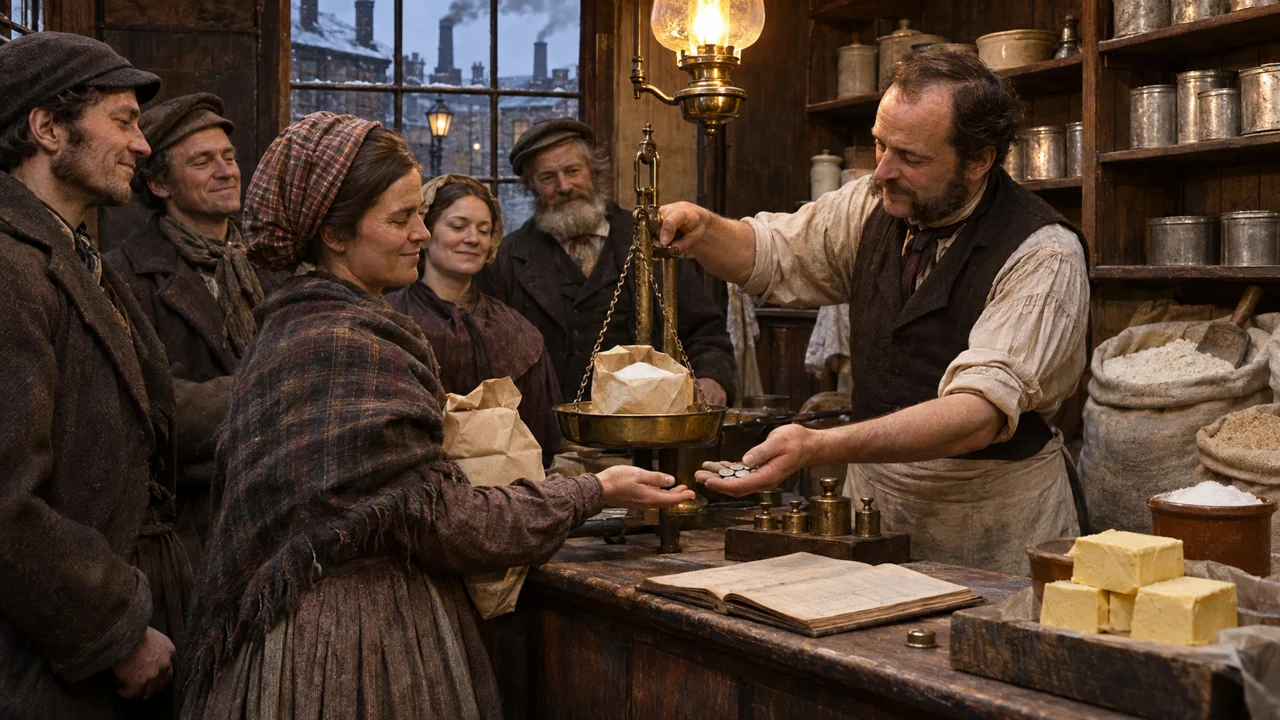
On the evening of 21 December the shop opened, at first only one or two evenings a week. The shelves held four goods: butter, sugar, flour and oatmeal, joined within months by tea and tobacco. The trade was modest, but it rested on a simple idea: the customers were also the owners. Each held a share, and the surplus did not go to a proprietor.
The mechanism fits in one line of the books. At the end of the first quarter, on 31 March 1845, members received three pence for every pound they had spent in the shop, about 1.25%. It was not interest on capital but a rebate proportional to purchases: the more you bought, the more you received. After a year the society counted about eighty members and £182 of capital.
Sharing by use rather than by capital
The idea overturns the usual logic of the firm. In a joint-stock company, profit follows the capital contributed; among the Pioneers it followed the use each member made of the shop. The customer stopped being the source of the profit and became its recipient, and every member had a say. The 1844 rules also made no distinction between men and women, and the first woman member, Eliza Brierley, joined in March 1846.
These practices, later grouped under the name of the Rochdale Principles, served as a model for consumer co-operatives in many countries. The society itself traded until 1991, when its activities were taken over by other co-operative groups, and by the Co-operative Group in 2007. The question it raises remains current, from mutuals to platforms: when a business belongs to its customers, who should receive its surplus?
A business changes nature the day its profit stops following capital and starts following purchases.