The island that was not
traded for Manhattan
On 31 July 1667 the Treaty of Breda ended the Second Anglo-Dutch War. Legend has it that the Dutch Republic gave up Manhattan to keep an island three kilometres long and one wide, planted with nutmeg trees. The text says nothing of the kind: it says that each side keeps what it holds.
Three kilometres by one
Until the middle of the nineteenth century the Banda Islands were the world's only source of nutmeg and mace. Run is the westernmost of them, the smallest and the hardest to hold. On 25 December 1616 Captain Nathaniel Courthope landed there for the English East India Company and had the inhabitants sign a deed acknowledging James I as their sovereign. He would hold the island for one thousand five hundred and forty days, until his death in 1620.
The Dutch company settled the matter in 1621. The population of the archipelago fell from some fourteen thousand people to about a thousand survivors, scattered through the groves as forced labour. Half a million nutmeg trees were carved into sixty-eight parcels of 1.2 hectares, handed to planters under contract. On Run, which it could not police, the company chose the other method: it cut down every tree.
The English re-occupied Run in 1664, the same year the Duke of York seized New Amsterdam and renamed it New York. The Dutch drove them out a second time. At Breda, article 3 adopted the principle of uti possidetis, what you hold, you keep, effective from 20 May 1667. The Dutch Republic kept Surinam, Fort Cormantin and Run; England kept New Netherland. Neither side gave anything up: each renounced a claim to what it had already lost.
The balance of power sits in a single accounting line. On the islands, the company paid its planters one hundred and twenty-second of the price of nutmeg on the Dutch market. The monopoly was not first of all a way of selling dear: it was a way of buying at a price nobody else could contest.
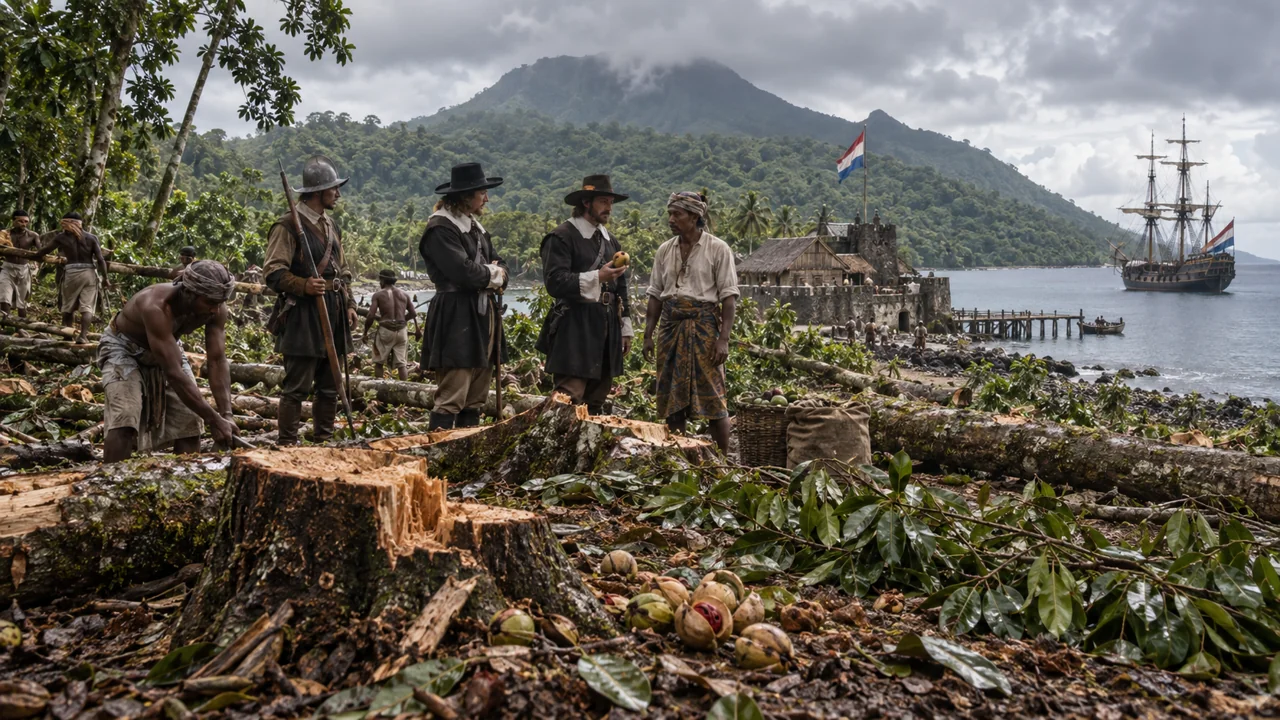
You do not buy an island, you extinguish an option
What Breda settled was not an exchange but a possibility. Run was worth nothing in itself: with no trees, it was a rock. Its value was that of an entry ticket, the chance for London to reopen a rival trading post one day and bring down the price of nutmeg in Amsterdam. The Dutch did not acquire an island, they extinguished an option. It is the most ordinary expense a monopoly bears, and the least legible in its accounts.
What followed shows how fragile the method was. A monopoly grounded in a place does not survive the moving of the plant: when the British took Banda in 1810 they carried seedlings off to Ceylon, Grenada and Singapore, and the rent died out within a few decades. Manhattan could not be moved.
In 1667 an island three kilometres by one was worth exactly what it stopped a competitor from doing.