A thousand economists
against a tariff
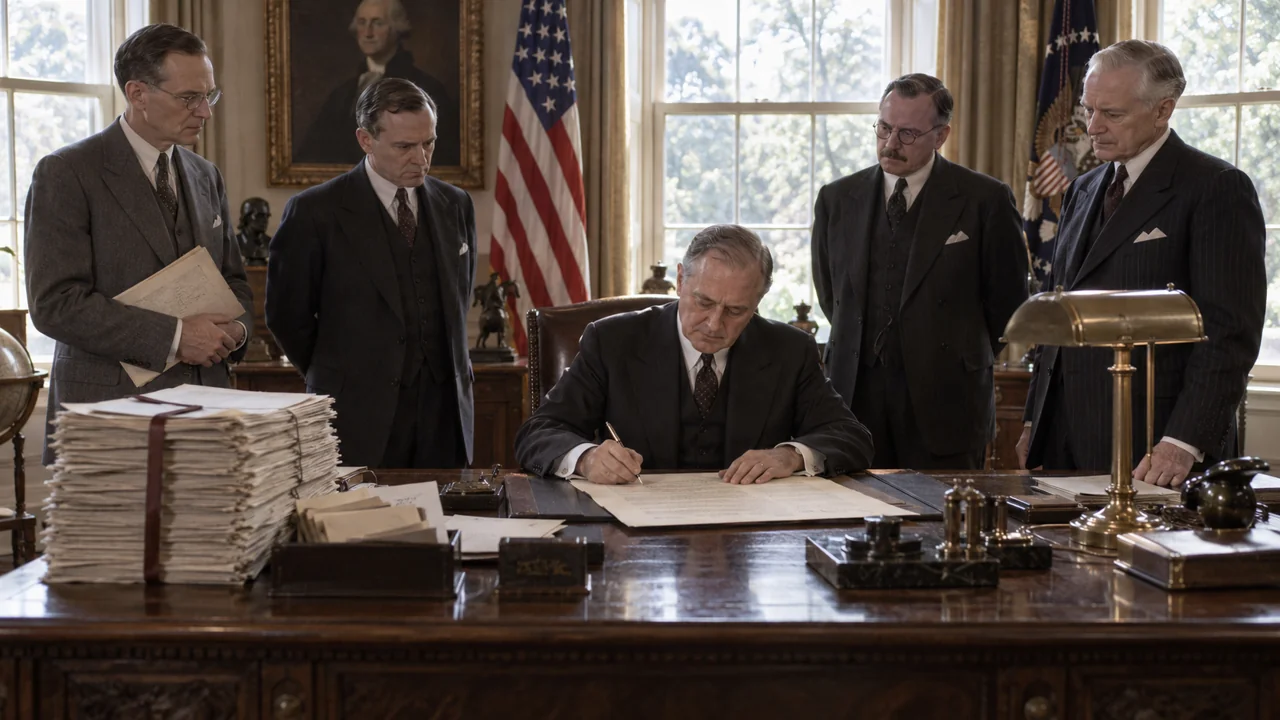
On 17 June 1930, President Herbert Hoover signed the Smoot-Hawley Tariff Act, raising American import duties. More than a thousand economists had begged him not to.
A law passed against the economists' advice
After the 1929 crash, Congress wanted to shield American farmers, then industry, from foreign competition. Senator Reed Smoot and Representative Willis Hawley, who chaired the committees involved, carried a bill that each chamber made heavier in its own way: the House raised 845 duties, the Senate 890.
In May 1930, more than a thousand economists signed an open letter asking Hoover to veto it. Henry Ford told him the tariff was "an economic stupidity." None of it worked: the Senate passed the bill by 44 votes to 42 on 13 June, the House approved it by 245 to 177, and Hoover signed on the 17th.
America's partners did not wait. Canada, its leading customer, imposed countervailing duties on sixteen products, covering about 30% of the value of US exports to it. Other countries followed. Each protected its producers by closing its market to the others, a logic economists call "beggar-thy-neighbor."
Protectionism is never played alone
US exports fell from $5.4 billion in 1929 to $2.1 billion three years later, and world trade shrank by as much as two-thirds by 1934. Nuance is needed, though: the Great Depression, deflation and the collapse of credit weighed more heavily than the tariff, whose average rate rose by only about 2.5 points. The law did not create the crisis; it closed doors just when they were needed most.
The lesson is one of reciprocity: a duty protects one producer from day one, but invites a reply that penalizes others. In 1934 Congress gave the president the power to negotiate duty reductions with each partner, a first step toward the GATT and then the WTO. The debate reopens whenever a state raises its barriers: whom does it protect, and who pays for the reply?
To close your door on your neighbors is to invite them to close theirs.