The market that ran
on post-dated cheques
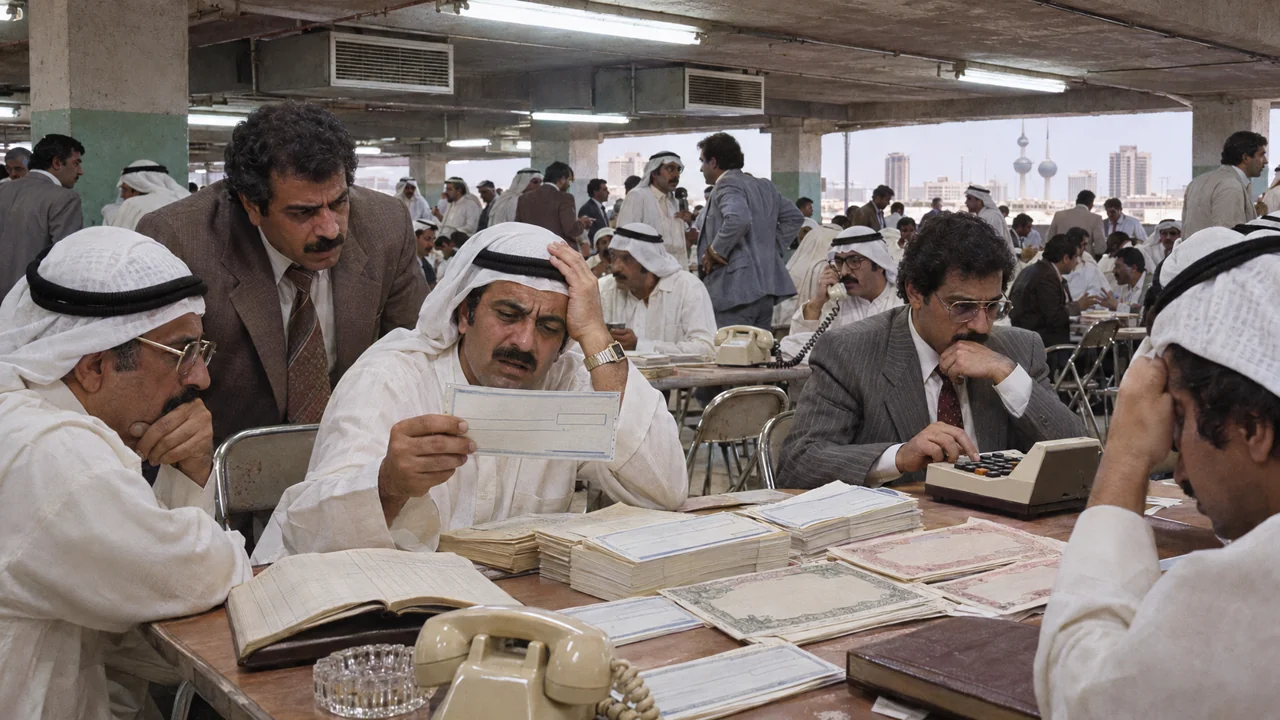
In August 1982, in Kuwait, a post-dated cheque presented for payment bounced. It was no isolated incident: on the Souk al-Manakh, a parallel stock market housed in an air-conditioned car park, almost every share was bought this way, with money that did not yet exist.
An exchange without clearing, at the back of a car park
After the 1977 crash, the Kuwaiti authorities tightened the rules of the official exchange. Investors found a way round: they set up companies in neighbouring Gulf states and traded them on an informal market, the Souk al-Manakh, in the Jibla district. It soon listed some seventy stocks, around forty of them domiciled outside Kuwait. At its peak, according to a study by the Federal Reserve Bank of Cleveland, the capital traded there was surpassed only by that of the American and Japanese markets.
The engine was a slip of paper. The buyer paid with a cheque dated several months ahead, counting on reselling at a profit before it fell due. The cheque then circulated in turn, at a discount, like money. There was no clearing house and no margin deposit: every trade rested on a private individual's promise, itself backed by the next rise.
When the first cheque bounced, every holder wanted to cash in at once. In September 1982, the Ministry of Finance ordered outstanding cheques to be declared and shut the market. The tally came to about 29,000 cheques, the equivalent of some $94 billion, written by about 6,000 investors. Every bank in the country but one, the National Bank of Kuwait, found itself technically insolvent, kept afloat by the Central Bank.
Credit created outside the banks
The Souk al-Manakh shows that a bubble does not need banks to create credit. The post-dated cheque served as a short-term loan, granted without any credit check and passed from hand to hand. The mass of these promises came to dwarf investors' real savings, because no one could see the total: each knew only their own counterparty.
That is precisely what a clearing house, a margin call or a short settlement period is for: to make each party's commitment visible and to cap it. The unwinding took years. The state set up a programme to settle difficult debts, still unfinished in 1990, and the Gulf stocks moved to Kuwait's official exchange. The question remains, for over-the-counter markets as for deferred payment: who sees the sum of the promises?
A market can live for years on promises dated tomorrow: it takes only one day when tomorrow arrives for everyone at once.