The auction that
replaced the lottery
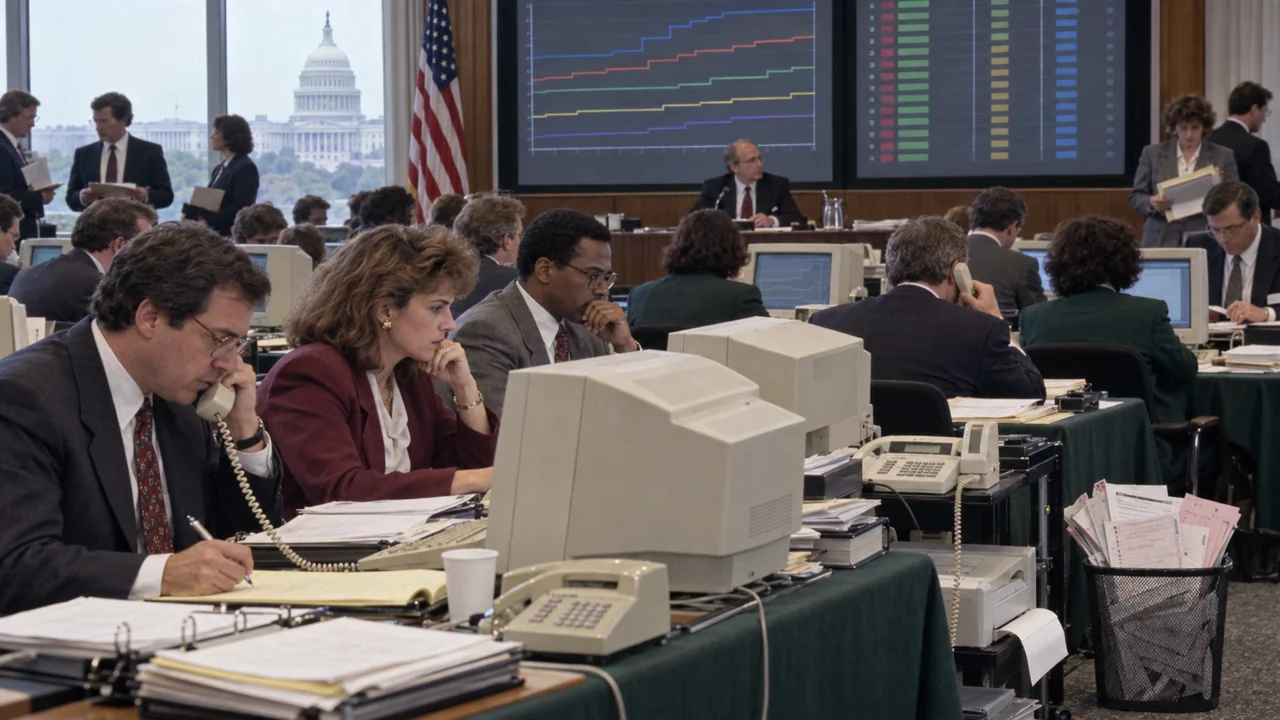
On 25 July 1994, in Washington, the federal communications regulator opened the first auction of radio frequencies. Five days and forty-seven rounds later, ten nationwide licences had found buyers for $617 million. The rules of the game had been written by three auction theorists.
Five days at the Omni Shoreham
Until then the American state did not sell its frequencies, it gave them away. The Federal Communications Commission chose between applicants through comparative hearings, and from 1981 by lottery. The procedure handed out free usage rights that the winner sometimes resold at once, at a gain the public purse never saw. The 1993 budget act added a section 309(j) to the Communications Act and authorised competitive bidding at last. Which form of bidding remained the question: a badly designed auction could allocate spectrum worse than a lottery.
The Commission consulted economists. Paul Milgrom, Robert Wilson and R. Preston McAfee proposed a format that had never been used, the simultaneous multiple-round ascending auction: every licence is offered at the same time, bids rise round after round, and nothing is knocked down while a single new bid survives anywhere. The reason is simple. Licences complement one another, and a bidder who wants two neighbouring regions does not value the second in the same way depending on whether he wins the first. Watching all the prices rise together, he can weigh instead of gamble.
The quantity sold was small: the ten licences carried 787.5 kilohertz in all, less than the room taken by four FM radio stations. Twenty-nine qualified bidders turned up, six left with a licence, for $617 million net. Prior estimates had been around a tenth of that sum.
What a mechanism can do
The episode marks a turn in the use of economic theory. The point was no longer to describe an existing market but to write its rules so that it would produce the wanted outcome: leading each participant, out of self-interest alone, to reveal what a frequency is worth to him. That mechanism engineering has since left the spectrum for electricity, airport slots, emission quotas. The revenue was the shop window, while the real stake lay elsewhere: putting the resource in the hands of whoever would use it best.
What followed was a reminder that a mechanism can always be improved. The credits set aside for small entrants fed front arrangements, and bidders learned to signal to one another through the trailing digits of their bids, until the Commission required rounded amounts. The format was nonetheless taken up by dozens of states, and Milgrom and Wilson received the Nobel prize in economics for this work in 2020.
In five days, a rule of the game put a price on a good that no one has ever seen.