The canal bought
without Parliament
On 25 November 1875, Britain signed in Cairo for 176,602 shares in the Suez Canal. Parliament was in recess and the Treasury could advance nothing: the four million pounds came from a private banking house, on a word.
A debtor in a hurry, a buyer in a hurry
Khedive Isma'il had modernised Egypt on credit. By 1875 the country's debt was approaching one hundred million pounds and the December instalment was out of reach. One first-rate asset remained to him: 176,602 shares in the Compagnie universelle du canal maritime de Suez, opened in 1869, close to 44% of the capital. Paris and London both knew it.
Benjamin Disraeli chose speed. Parliament was in recess, no credit could be voted, and the Treasury did not have the sum. The banker Lionel de Rothschild advanced four million pounds with no formal security. The contract was signed in Cairo on 25 November 1875 for £3,976,582, and the shares were lodged the next day at the British consulate. The Commons were not asked to approve the outlay until 21 February 1876; Gladstone saw in it a breach of the constitutional order.
The oddest part is the security itself. Isma'il had already sold away the coupons on his shares until 1894: London was therefore paying nearly four million for stock that would pay no dividend for nineteen years, with the Khedive undertaking to pay 5% interest in the meantime. Having forfeited his rights as a director, he could not pass them on either: the canal's largest shareholder held, at first, no seat on the board.
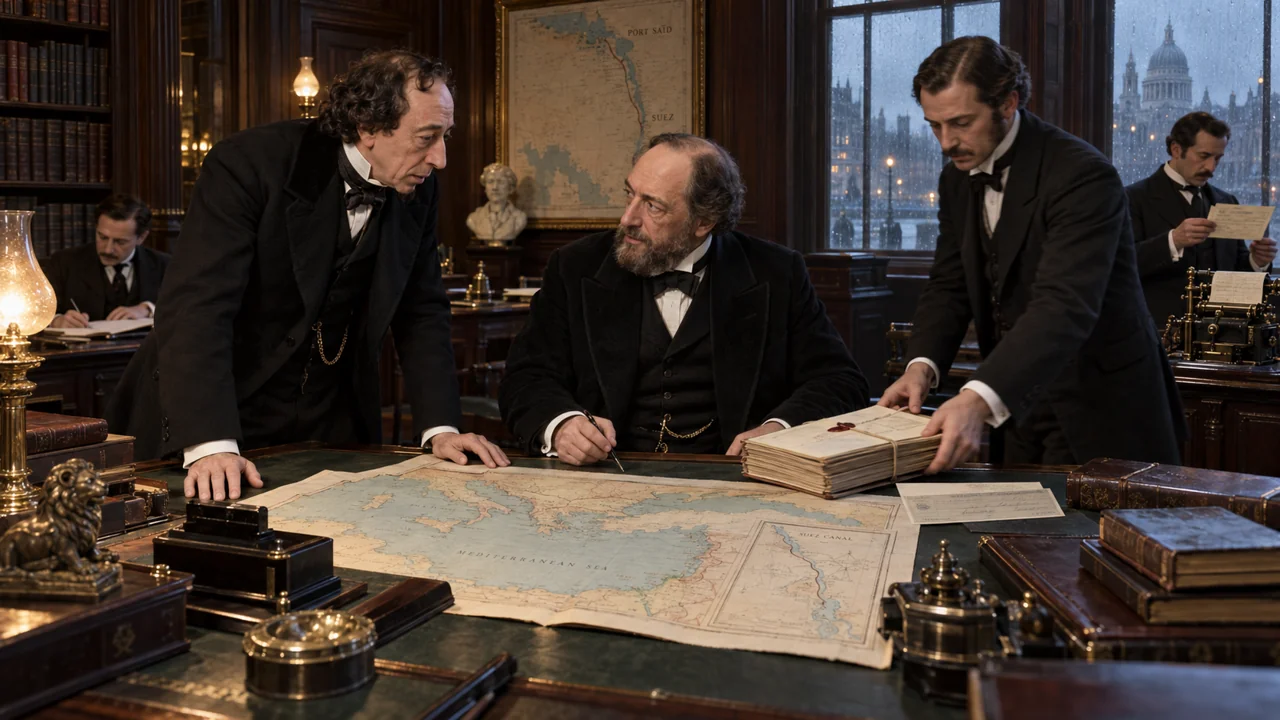
What a state buys when it buys a security
No ordinary investor would have signed such a contract: no income, no vote, no security. London was not buying a yield but a position on the route to India. An asset is sometimes paid for what it commands rather than what it returns; strategic value and financial value are not the same quantity, and a state will occasionally accept a loss on the second to obtain the first.
The other face of the episode is less glorious. A cornered sovereign debtor sells its best asset at the worst moment, the one at which it can no longer keep it, and the sale does not save it: the Egyptian public debt commission was set up in 1876, Anglo-French control followed, then the occupation of 1882. The question stays open in today's arguments over the ownership of ports, cables and straits: who holds the chokepoints of trade, and at what price are they given up?
A strategic asset always sells at the worst moment, the one when it can no longer be kept.