The coin that never
changed its date
On 29 November 1780, Maria Theresa of Austria died. Her coin, however, did not stop being born: from that day on, every thaler struck in her likeness has carried the same date, 1780. Two and a half centuries later, it is still being minted.
A coin struck for two and a half centuries
The thaler bearing Maria Theresa's likeness was first struck in 1741, then aligned in 1751 with the monetary convention that fixed its standard. The coin weighs 28.07 grams and contains 23.39 grams of fine silver, a fineness of 833 thousandths. That regularity made its fortune: in a world of clipped and debased currencies, you knew exactly what you were holding.
On the sovereign's death, Vienna took a curious decision: never change the date again. Merchants of the Red Sea, Arabia and Ethiopia would accept only that portrait and that year; any change would have raised suspicion. Francis Joseph made it an official trade coin on 19 September 1857, and it lost legal-tender status in Austria on 31 October 1858. Yet it went on circulating from North Africa to Somalia, from Yemen to Oman, where it was called the riyal fransi, the "French riyal", so widely was it believed to come from Paris.
In 1935 Mussolini bought from Austria the exclusive twenty-five-year concession to strike it: he needed this coin, not the lira, to pay for his conquest of Ethiopia. London, Paris and Brussels promptly began striking it without permission. In the early 1940s the British produced some eighteen million in Bombay to fund their East African campaign against the Italians. Two warring camps were minting the same money, under the same date. The concession lapsed in 1961; the United Kingdom was the last to give it up, in February 1962.
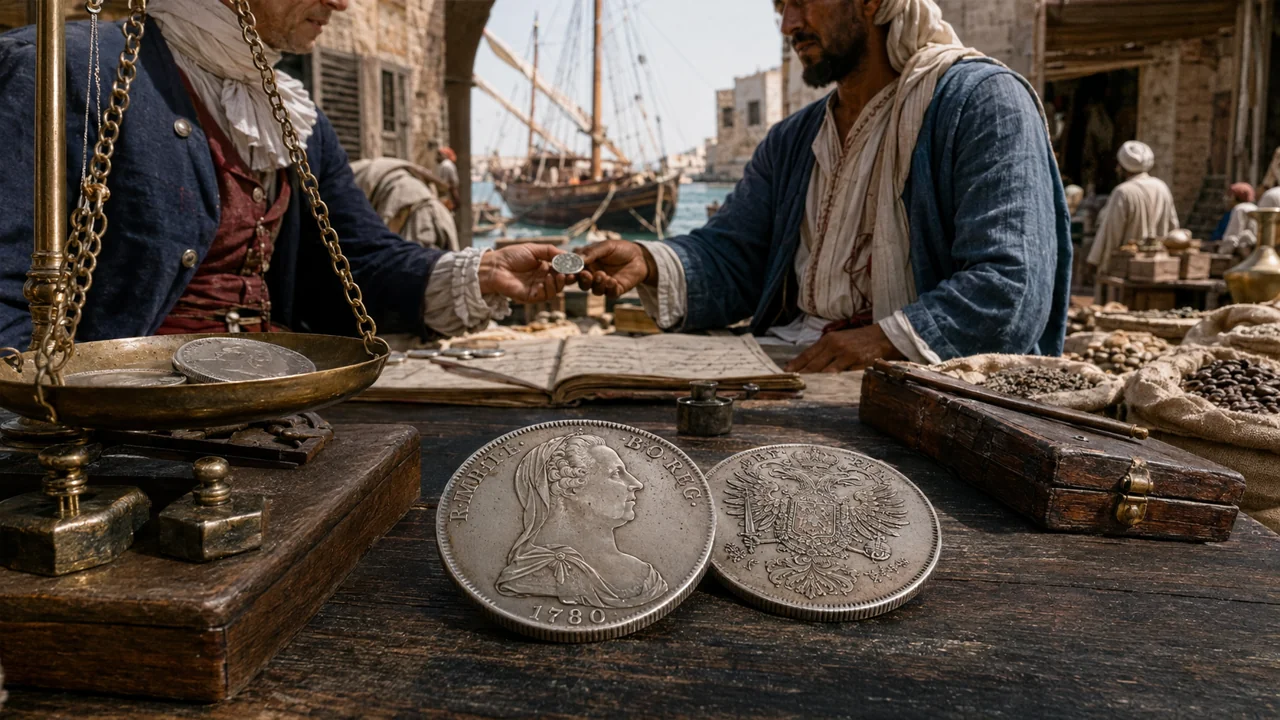
It is users who decide what counts as money
Some 389 million thalers were struck between 1751 and 2000, by a dozen mints from Vienna to Bombay. No state really governed this money: Austria had withdrawn it from its own system in 1858, and the empire that created it had ceased to exist in 1918. It circulated all the same, because populations spread over three continents had decided that it held value.
The attempts to replace it confirm as much. Italy's Eritrean tallero of 1890, then the thalers struck by Menelik II with his own likeness, imitated the coin without ever dislodging it. It was, on the other hand, the acknowledged ancestor of the Saudi riyal and the Ethiopian birr. The lesson goes beyond numismatics: a currency is not imposed by whoever issues it, it is kept by those who accept it. That is still what is at stake in the dollarisation of certain economies.
A currency belongs not to whoever strikes it, but to those who take it without hesitation.