The telegraph
that printed prices
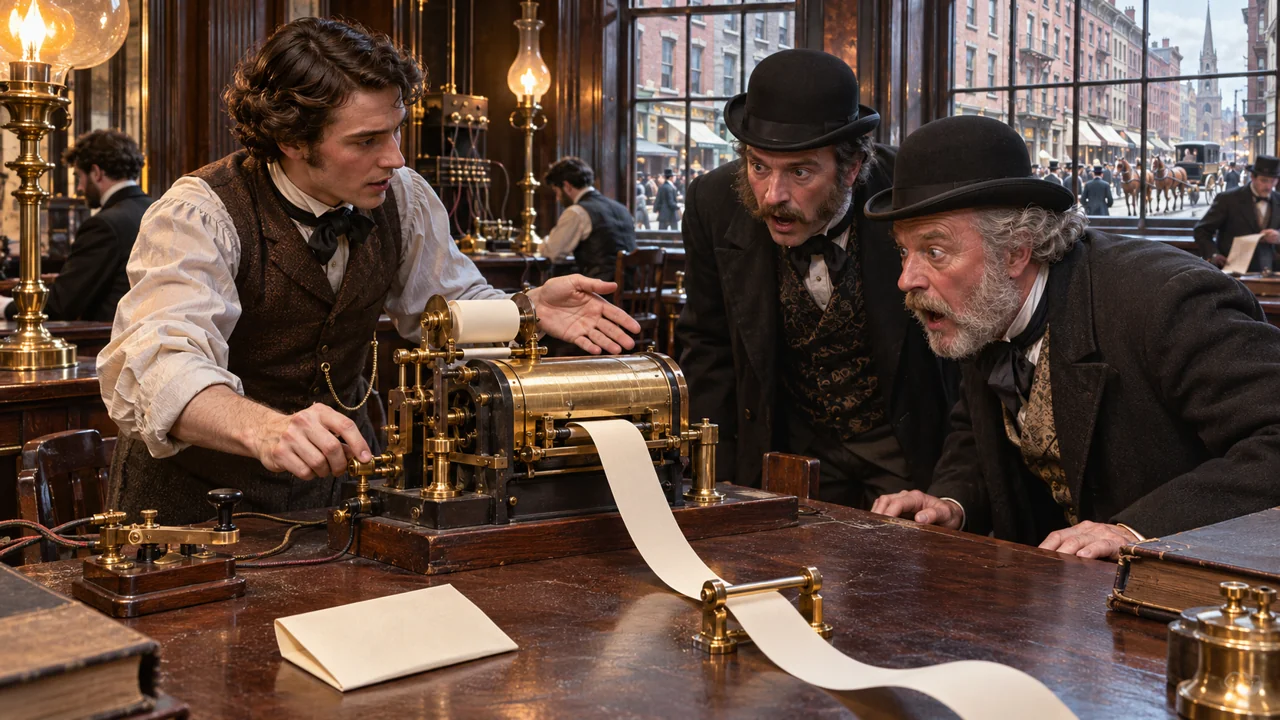
On 15 November 1867, in New York, the telegrapher Edward A. Calahan unveiled a machine that printed stock exchange prices on a narrow strip of paper. The clatter of its type wheel gave it its name: the “ticker”.
A strip of paper in every office
Until then, prices struck on the New York Stock Exchange travelled by mail or by messenger. A broker a few streets from the floor learned of them late, and whoever stood closest to the trading kept a step ahead. Calahan, an employee of the American Telegraph Company, adapted the printing telegraph: an operator at the Exchange sent out the transactions, and receivers installed at subscribers’ premises printed them at the same moment, in letters and figures, on a paper ribbon.
A company was formed in August 1867 to exploit the invention, the Gold and Stock Telegraph Company. Success came quickly, but the machine had a flaw: receivers fell out of step and printed shifted characters, so staff had to be sent to clients’ offices to bring them back into line. A young telegrapher, Thomas Edison, took on the problem; his Universal Stock Printer, developed in 1871 for Gold and Stock, automatically aligned every instrument on a line. That same year, Western Union took control of the company.
The ticker was no racer: machines of the period printed on the order of one character per second. Hence an economy of signs that outlived the machine: every listed company is designated by an abbreviation of a few letters, the ticker symbol still shown on every platform. The spent tape even found a second life: on 28 October 1886, the day the Statue of Liberty was dedicated, Wall Street clerks threw it from their windows onto the procession, the first of New York’s ticker-tape parades.
Price becomes shared information
The ticker changed the very nature of the market. Price stopped being a piece of news carried by hand and became a continuous flow, received at the same instant in many offices. The advantage of physical proximity partly faded, the market spilled beyond the floor, and a new practice emerged, tape reading: speculators spent their days interpreting the sequence of prices and volumes to guess what came next. It is often seen as one of the ancestors of technical analysis.
The episode illustrates a central idea of the economics of information: a market works better the faster and more equal access to prices is. Yet each gain in speed has shifted the frontier of advantage, from messenger to telegraph, then from telegraph to the electronic displays that replaced mechanical tickers in the 1960s, and on to the ultra-low-latency links of high-frequency trading. The crawl that still runs along the bottom of news channels keeps the memory of Calahan’s machine.
The day prices began to scroll, the Exchange stepped outside its walls.