The franc that
four countries shared
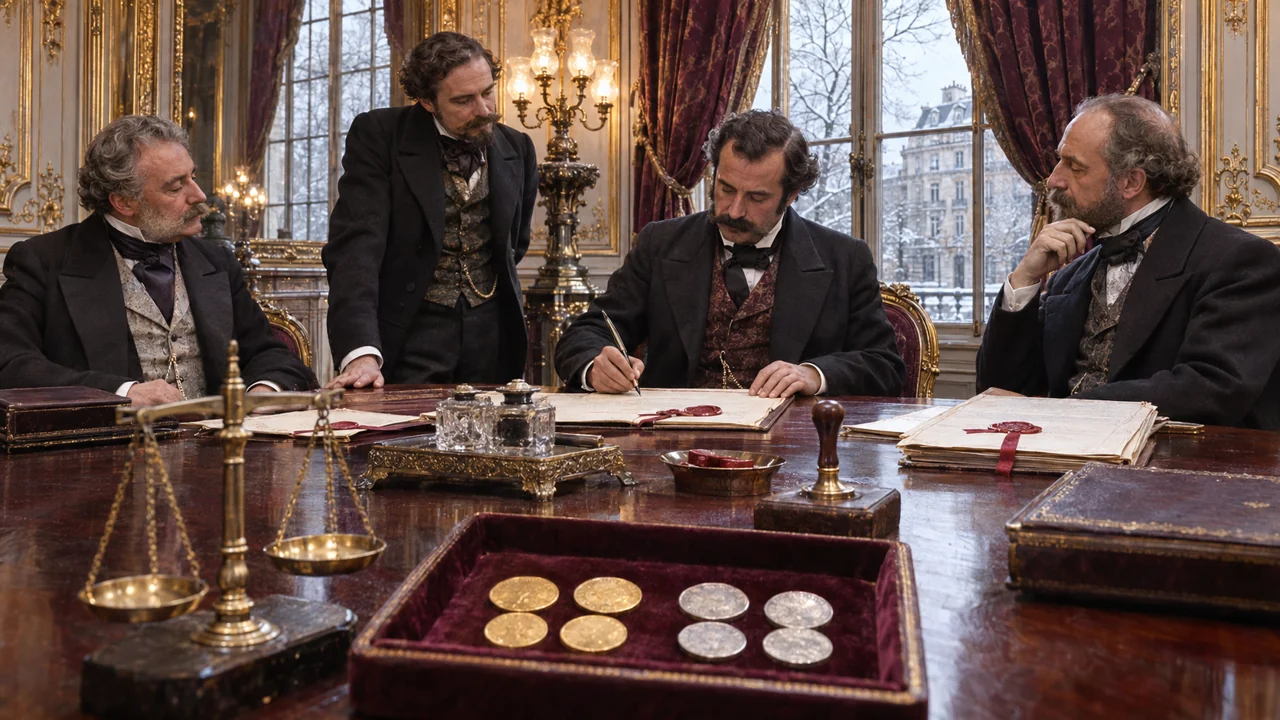
On 23 December 1865, France, Belgium, Italy and Switzerland signed a convention in Paris giving their gold and silver coins the same weight and fineness. It was the first common currency of modern Europe, born of a very concrete problem: coins that crossed borders without being worth the same.
One coin, four countries
By the 1860s the franc had become the de facto standard for several of France's neighbours, but each struck its coins as it pleased. Small silver coins of unequal fineness circulated on both sides of the borders, and those with less metal drove out the better ones, as Gresham's law predicts. The Paris convention, in force from 1 August 1866, ended the confusion.
The rules fit into a few figures. The 20-franc gold coin weighed 6.45 grams at 900 thousandths fineness. The 5-franc silver coin weighed 25 grams at the same fineness, with the smaller denominations at 835 thousandths. A fixed ratio of 15.5 to 1 tied the two metals together. Each state struck its own effigies, but the coins were interchangeable. Greece joined in 1867, and several other countries, from Finland to Bulgaria, aligned their money on the same model.
The system rested on bimetallism, and that was its flaw. In 1873 the price of silver collapsed: striking silver against gold at 15.5 to 1 became profitable, and the mints were flooded. A Paris agreement of 30 January 1874 limited coinage, and silver coinage was then suspended in 1878. The Union lived on as a de facto gold standard.
A common currency without a common authority
The Latin Monetary Union had no central bank and no shared treasury: the convention governed coins for the most part, and each state remained master of its own finances. As long as the rule was shared, the money circulated freely. Once a member could profit from the common rule, no authority stood ready to stop it.
The First World War hollowed it out, as states financed the war effort by issuing paper. Its formal dissolution came only in 1927, but it was by then little more than a memory. The question raised in 1865 remains alive: what must be shared along with a currency, a unit of account or a discipline as well?
A common currency lasts only as long as each member gives up the advantage of striking money for its own account.