The Friday they
tried to corner gold
On 24 September 1869, two New York financiers tried to corner the gold of the United States. It took only the Treasury stepping in to send the price crashing within hours and drag Wall Street into panic.
A bet on a metal that barely circulated
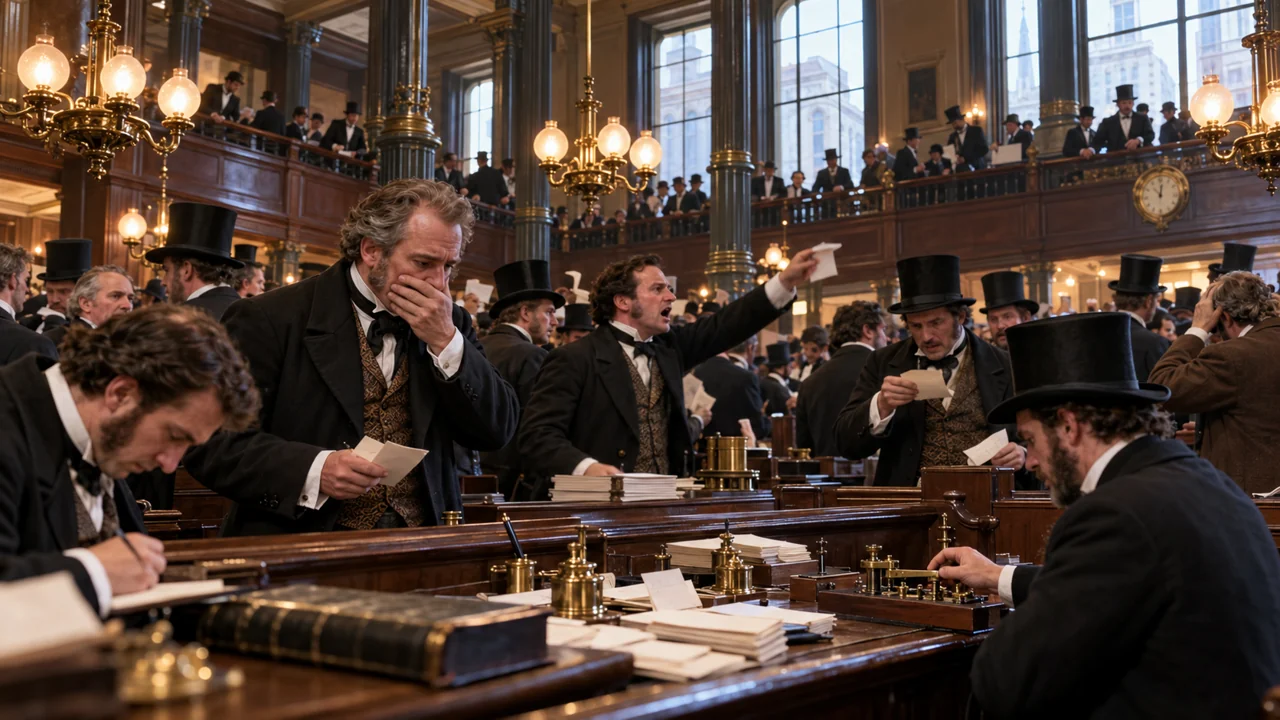
Since 1862 the paper dollar, the “greenback”, had no longer been convertible into gold. The metal traded separately, against greenbacks, in a New York trading room called the Gold Room, and its price moved with confidence. In the summer of 1869 Jay Gould and James Fisk, executives of the Erie Railroad, set out to buy it in bulk. Their reasoning: according to the New York Fed, only about $15 million of gold was actually circulating on the market, while the Treasury held far more. If the government refrained from selling, scarce gold would be unaffordable for those who had promised to deliver it.
To make sure the Treasury stayed still, they cultivated the circle of President Ulysses Grant, including his brother-in-law Abel Corbin, and argued that dearer gold, by weakening the dollar, would help grain exports. On Friday 24 September gold opened at about $145 and climbed past $160. But Grant had grasped the manoeuvre: the previous evening he had authorised Treasury Secretary George Boutwell to sell $4 million of gold. As soon as the news reached the room, the price collapsed to around $133.
The mechanism fits in one sentence: a corner works only as long as no one powerful enough can sell. Those who had sold gold forward had to deliver it at any price; the Treasury, holder of a large stock, could reopen the tap with a word. Four million dollars, a modest sum for a state but enormous for so narrow a market, was enough to turn everything around.
A narrow market is a manipulable market
The shock did not stop at gold. Forced to cover their positions, speculators sold securities, and the stock market fell by about a fifth, according to the New York Fed. Several brokerage houses went bankrupt, and the Gold Room closed for days to untangle the trades. Gould came out enriched and Fisk repudiated his commitments; Congress investigated, and the reputation of the Grant administration was left dented.
The episode shows how much a thin market depends on whoever can supply it. When the quantity actually traded is small next to the stock held elsewhere, a determined buyer can set the price, and only the holder of the missing stock can undo him. The pattern echoes well beyond 1869, from the Hunt brothers and silver in 1980 to every debate on manipulating thinly traded markets: where liquidity is shallow, the price is a rumour. And a state that holds the stock is never a neutral player.
A market is free only as long as no one has the means to hold it back.