The world's oldest share
is a receipt
On 9 September 1606, the Enkhuizen chamber of the Dutch East India Company handed a townsman a sheet of paper confirming that he had paid off his one hundred and fifty guilders. Rediscovered in 2010, it passes for the oldest share in the world. It was not a share: ownership lay elsewhere.
A receipt forgotten in the Enkhuizen archives
The Company was born on 20 March 1602 from a charter of the States General granting it, for twenty-one years, a monopoly on trade east of the Cape of Good Hope. Its capital was raised by public subscription through six chambers, for 6,424,588 guilders; the Amsterdam chamber alone gathered nearly 3.7 million from 1,143 subscribers. For the first time, a company opened its capital to anyone who wanted in, from the great merchant to the housemaid.
Yet the subscribers received no certificate. The Company issued no bearer shares: the bookkeeper kept a large ledger in which every shareholder had an account, and it was that line, and that line only, that constituted ownership. Paying the final instalment earned nothing more than a receipt. On 9 September 1606, the Enkhuizen chamber issued one to Pieter Harmensz, a town messenger, for one hundred and fifty guilders. It lay in the municipal archives, now held at the Westfries Archief in Hoorn, until a student from Utrecht, Ruben Schalk, unearthed it in 2010 while working on his thesis.
The receipt could not be sold. To pass on a stake, one had to appear before the bookkeeper and two directors, who entered the transfer in the ledger. On 3 March 1603, Jan Allertsz sold 2,400 guilders of his holding to Maria van Egmont, then six hundred guilders more the same day: the first recorded transfer, and the birth certificate of the secondary market.
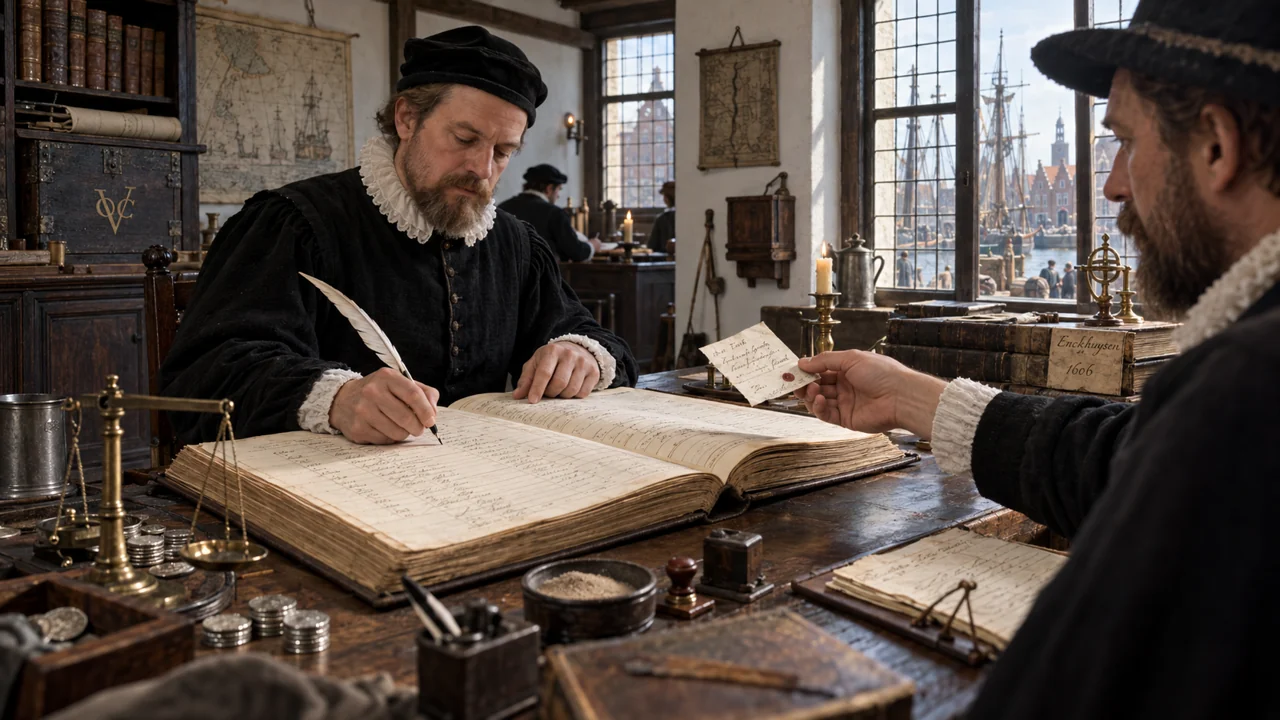
Ownership is not in the paper, it is in the book
The 1602 charter had closed a door: the capital was not repayable before the twenty-one-year term. A shareholder in a hurry could not ask the Company for his money back, only find someone to take his place. Out of that impossibility grew the need for a market, and then for an organised one. Liquidity is not a natural property of an investment; it is an institution built to make a long commitment bearable.
The rest lies in the mechanics of the ledger. What makes a stake a share is not the object held in hand, but the entry a trusted third party keeps on your behalf, and the right to transfer it. Four centuries on, the demonstration is everywhere: securities have been dematerialised, a portfolio is read off a securities account, and distributed ledgers merely restate, in another form, the question of 1602. Who keeps the book, and why do we believe it? The Enkhuizen sheet is worth a collector's fortune today. It was never worth a share.
A security was never a piece of paper: it is a line someone keeps for you.