Six months of
closed Wednesdays
On 12 June 1968 the leading financial marketplace in the world gave up opening one day a week. No strike, no day of mourning: its clerks could no longer keep up with the paper certificates that the previous day's orders had moved from one owner to another.
An exchange closed to catch up on its paper
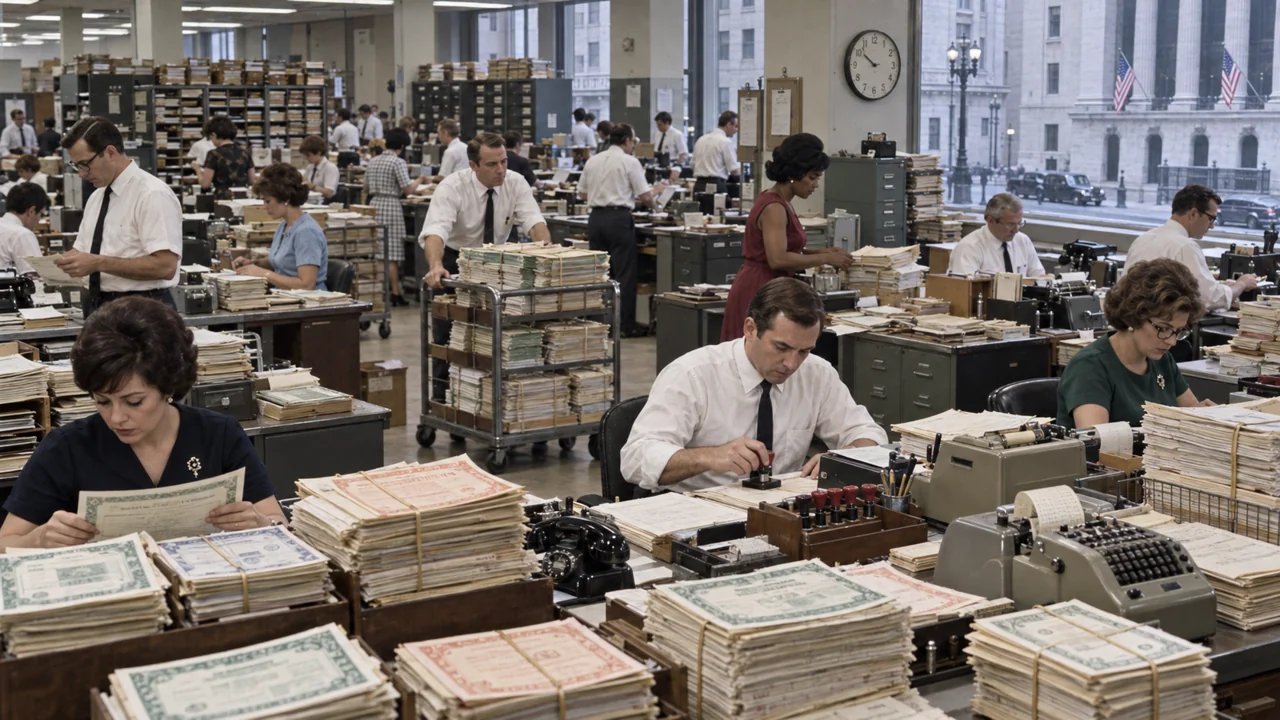
Nothing settled without paper in the 1960s. Every trade meant moving an engraved certificate, together with a signed transfer form, checking a signature, entering a name in a register. The method holds as long as volumes stay modest. Yet the average daily volume on the New York Stock Exchange rose from about 4.9 million securities in 1964 to 14.9 million four years later. Sheltered by fixed commissions, brokerage houses had invested little in computers. Clerks worked seven days a week, night shifts were hired, and the certificates piled up all the same.
The Securities and Exchange Commission first shortened the trading day, in August 1967 and then in early 1968, with little effect. On 12 June the exchange took the most visible measure there was: it would close every Wednesday until 31 December, so that back offices could work through the backlog. One house had already gone under, Pickard & Company, in May.
The scale of the disorder shows less in the delays than in the securities lost. In its 1971 study of broker-dealer practices, the Commission noted that at several houses the value of untraceable securities owed to customers exceeded their capital by a factor of two. The confusion also made a convenient cover: an estimated 100 to 400 million dollars was taken between 1964 and 1969.
What a market promises and what it delivers
The final blow came not from the paper but from the calendar. In the year following May 1969 the Dow Jones index lost 35%; volumes receded and revenues collapsed at houses whose costs had risen. A hundred and sixty member organisations of the New York Stock Exchange disappeared, about half of them through merger. The fall of Goodbody & Company, the country's fifth largest broker, cost the exchange's trust fund 21 million dollars in October 1970; in December Congress passed the act creating insurance for securities accounts. Then the certificate itself was set aside: the Depository Trust Company, in 1973, locked it in a single vault and settled trades by book entry.
The episode points to the part of a market no one ever looks at. A price forms in a second; delivery depends on staff, deadlines and machines, and that is where risk builds up unseen. Shortening the settlement cycle is therefore not plumbing: it means reducing the time during which a promise to exchange remains a promise.
For six months, the New York Stock Exchange paid for its backlog of entries with one trading day less each week.