The town that made
its money rust
On 31 July 1932, a small town in the Tyrol put its own currency into circulation, designed to lose one percent of its value every month. The idea came from a theorist who had died two years earlier. It worked well enough for the central bank to end it.
A banknote that cost its holder to keep
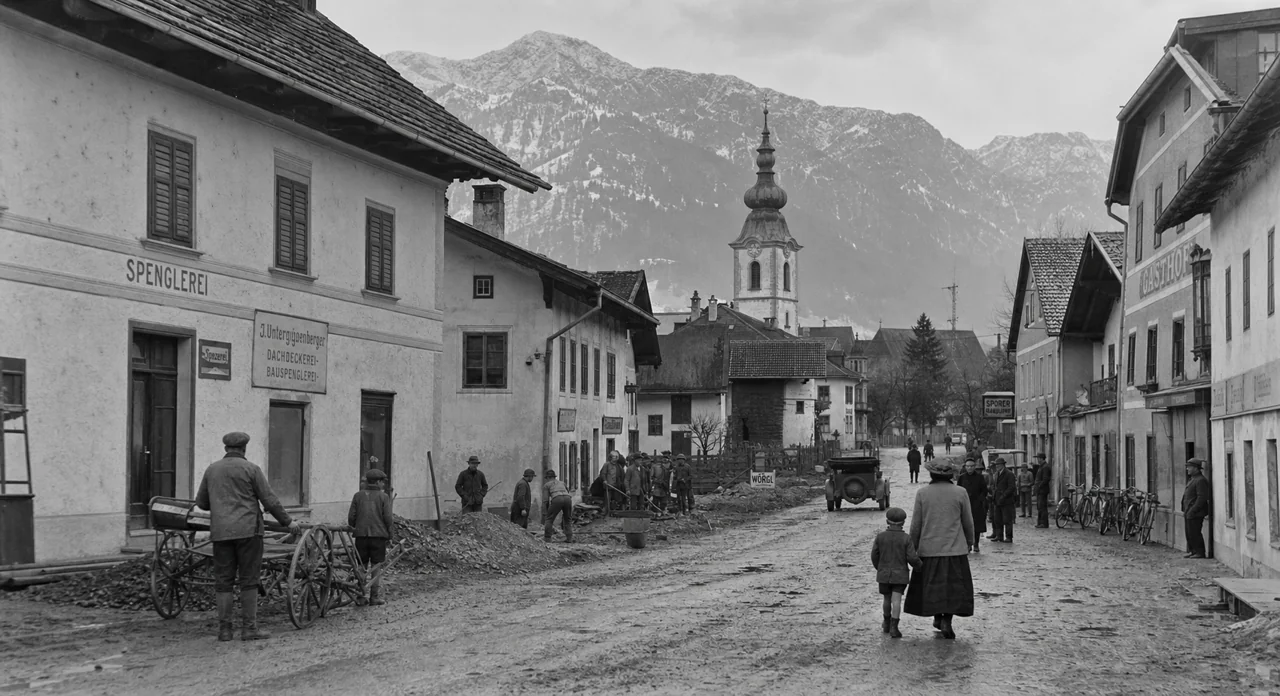
Wörgl, four thousand two hundred people on the river Inn, was running at half speed: the cement and cellulose works had slowed, the district counted some fifteen hundred unemployed, and the town could no longer collect its taxes. Its mayor, Michael Unterguggenberger, a railwayman by trade, had read Silvio Gesell, the author of "free money," who held that money ought to depreciate the way goods decay, so that no one has an interest in leaving it still. On 8 July 1932 the town council approved his relief plan unanimously.
On 31 July the town issued "labour certificates," backed schilling for schilling by a deposit at the local bank. Each note had to receive, at the end of the month, a stamp worth 1% of its face value, failing which it was no longer accepted; converting it back into schillings cost 2%. The town paid its wages and its suppliers in these notes and took them back in payment of taxes. In thirteen months it rebuilt roads and the water supply, a bridge and a ski jump. Unemployment fell by about 16% in Wörgl while it rose by 19% in the rest of the country.
The mechanism fits in one sentence: nobody wants to be the one holding the note on the last day of the month. Wörgl's currency was a tax on stillness, a negative interest rate applied not to deposits but to the notes themselves. A modest sum, a few thousand schillings, thus paid for many things in turn.
Not the quantity of money, but its movement
Wörgl made visible a variable that is easily forgotten: the velocity of circulation. In a deflation money is not always scarce, it simply stops moving, because waiting pays. Taxing the holding of money rather than saving reverses that calculation. The idea is no piece of folklore: it is precisely what the negative policy rates of the 2010s in Europe and Japan were after, with the difference that they hit banks' reserves rather than households' banknotes. The economist Irving Fisher took an interest in the case and devoted a short book to stamp scrip as early as 1933.
Caution is still in order. The experiment lasted thirteen months in a tiny municipality, its circulation figures are disputed, and part of the effect simply came from the public spending the issue financed. What remains is the essential: the Austrian National Bank ended it on 1 September 1933 in the name of its monopoly on issuing currency, and the town lost its appeal in November. A monetary rule that fitted on one line had been enough to change a behaviour, which is precisely why it was stopped.
Money that costs its holder to keep never sleeps.