The Age of the Vengeful Supply Side:
why the next lasting economic shock has already begun
While governments and investors keep waiting for a return to the zero rates and free money of the 2010s, a strategic note from Deutsche Bank Research sounds the alarm: secular stagnation was a historical anomaly. The world economy has moved squarely into a regime of scarcity, geopolitical tension and supply rigidity.
"Scarcity, structural inflation, durably high rates." Far from a mere cyclical hiccup that central banks could smooth away, the current trajectory of world markets marks the definitive closing of a ten-year parenthesis that many had wrongly taken for the new normal of the modern economy.
1. The illusion of the free decade: anatomy of secular stagnation
Between the financial crash of 2008 and the health crisis of 2020, developed states experienced what looks, in hindsight, like a theoretical aberration: borrowing at unprecedented levels without ever facing the slightest sanction in the form of runaway inflation or a surge in bond yields. Germany issued 10-year government debt at negative rates reaching −0.7%, while the US Treasury saw its 10-year flirt with a historic floor of 0.51%.

Yet there was nothing magical about this dynamic. It was the product of a major economic trauma: the Great Recession that followed the collapse of Lehman Brothers. Facing the worst contraction since the 1930s, over-indebted households and firms cut short their investment plans to protect their savings.
This structural imbalance, theorised by economists under the concept of secular stagnation, meant that a colossal mass of private capital was desperately seeking safe assets without finding profitable investment opportunities. To restore full-employment equilibrium, the natural rate of interest had turned deeply negative. Governments could then multiply debt issuance: there was always a private creditor to absorb the paper, giving the fatal illusion that the budget constraint of states had been abolished forever.
2. The post-Covid stimulus trap: the collision of demand and supply
The onset of the pandemic in 2020 broke this mechanism. Conditioned by ten years of free debt and haunted by the spectre of deflation, governments applied the usual recipes of monetary and fiscal stimulus, but on an exponential scale: direct transfers to households, stimulus cheques and massive liquidity guarantees.
But unlike the 2008 crisis, the pandemic was not a simple crisis of private demand confidence: it was first and foremost a violent negative supply shock. Idle factories, disorganised supply chains, maritime bottlenecks and labour shortages mechanically reduced global production potential. Injecting a historic wave of purchasing power into an economy whose productive capacity is restricted produces an inescapable arithmetic consequence: surging prices.
While central banks initially proclaimed that this inflationary surge would be merely transitory, reality resisted. Policy rates had to be raised at a forced march (525 basis points in the United States, 450 in Europe), and inflation is structurally struggling to return to its 2% target.
3. Three geopolitical shocks that dismembered global supply
If overheating conditions persist, it is because supply disruptions did not dissipate with the end of Covid. Three major geopolitical shocks fragmented global value chains, making world productive capacity far more rigid and costly.
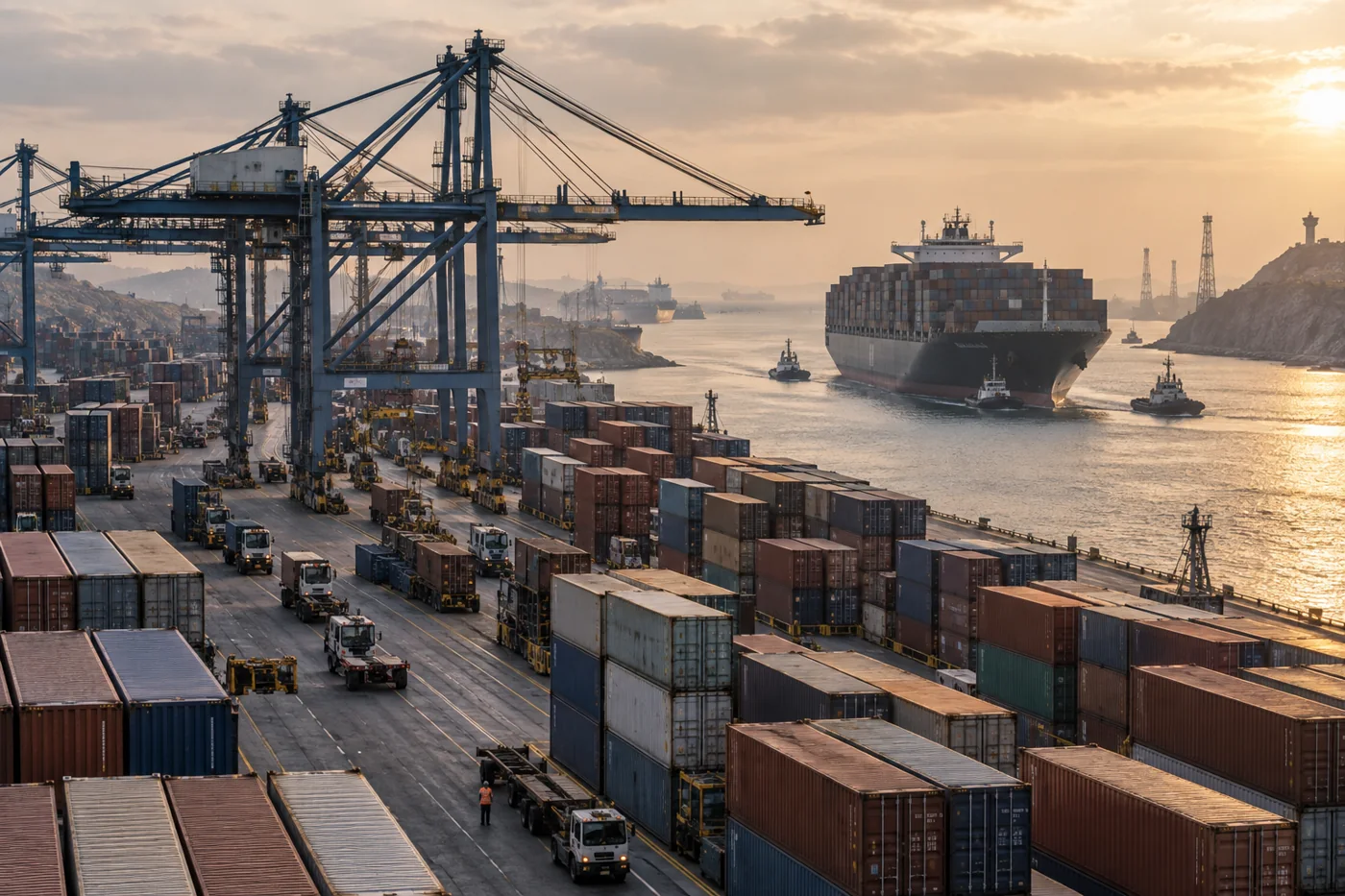
February 2022, the Ukrainian shockwave. Russia's aggression against Ukraine triggered a historic surge in European gas prices, forcing the continent into a brutal energy weaning and costly LNG imports. Black Sea port blockades sent grain markets soaring.
April 2025, the American protectionist blast. The average effective US tariff rate rose from about 2.6% to more than 23% (up to roughly 27% at its peak) before easing back to around 11 to 15%, forcing firms into costly relocations.
Middle East escalation and the Strait of Hormuz. The conflict involving Iran heavily disrupted and diverted the transit of about 15 million barrels per day (nearly 25% of seaborne crude). Brent crossed 85 then 100 dollars, peaking around 118.
Each of these episodes cut into world productivity. When supply is constrained and governments keep feeding demand through crisis-scale deficits in peacetime, higher prices and rates become the only short-term rebalancing mechanism.
4. The uncomfortable mirror of the 1970s: three forgotten warnings
This configuration echoes the stagflationary crisis of the 1970s: the 1973 oil embargo during the Yom Kippur War, and the second shock following the 1979 Iranian revolution and the Iran-Iraq war. Three lessons stand out.
| Historical lesson | Macroeconomic mechanism | Consequence if ignored |
|---|---|---|
| Accumulating shocks unanchor expectations | The repetition of successive supply shocks entrenches the expectation of permanent inflation. | Wage-price spirals and loss of confidence in the currency. |
| Do not stimulate demand against a supply deficit | Monetary policy does not drill wells or manufacture semiconductors. Cutting rates against a shortage of goods only produces higher prices. | A dead end leading to a destructive rate shock, like the Volcker cure of the early 1980s. |
| Public deficits crowd out productive capital | When supply is rigid, public spending monopolises available capital and pushes rates up. | Crowding-out effect: firms give up modernising their productive base. |
5. The Deutsche Bank thesis: toward an unapologetic supply-side policy
Faced with this new landscape, the Deutsche Bank report ("The Revenge of the Supply Side", September 2026) urges a complete change of paradigm. Over the past fifteen years, the debate was confined to how much money to inject and how much debt to contract to restart the machine.
Yet treating a supply problem with a continuous drip of demand is an aberration that sustains the soaring cost of money and drains the financing of essential industrial projects.

To loosen the vice, economic research suggests three immediate imperatives.
- Restore fiscal discipline: stop financing artificial demand with a cavalry of debt that crowds out private investment.
- Dismantle regulatory bottlenecks: ease the barriers that paralyse housing, the energy transition and industry.
- Mobilise human capital: reform labour markets to favour integration and training.
In a world where supply will not bend to decrees, the question is no longer whether frantic stimulus policies will stop, but which of the two, governments or the discipline of financial markets, will yield first.DfinA synthesis
- Deutsche Bank Research (September 2026): "The Revenge of the Supply Side: A New Economic Regime".
- Lawrence Summers (2013-2020): the secular stagnation hypothesis and the negative natural rate.
- Yale Budget Lab (2025-2026): average effective US tariff rate.
- IEA / EIA: volumes and share of the Strait of Hormuz in world oil trade.
- CBO, Federal Reserve, ECB: 2020 federal deficit (14.9% of GDP) and tightening (Fed +525 bp, ECB +450 bp).