The disowned note
that gained value
On 10 May 1993 the Central Bank of Iraq stopped honouring its own twenty-five-dinar notes. In the north of the country, cut off from Baghdad, those issuerless notes remained the only money available. Ten years later, one of them traded for three hundred official notes.
A currency left without an issuer
Until 1990 Iraq did not make its own banknotes: they were printed in the United Kingdom by De La Rue, from plates said to be Swiss, hence the nickname "Swiss dinar". The embargo that followed the Gulf War closed that door. Baghdad then had notes printed at home and in China, of poor quality, on ordinary paper, bearing the likeness of Saddam Hussein. On 5 May 1993 a statement gave holders of the old twenty-five-dinar notes six days to bring them to the counters. After 10 May, the central bank no longer recognised them.
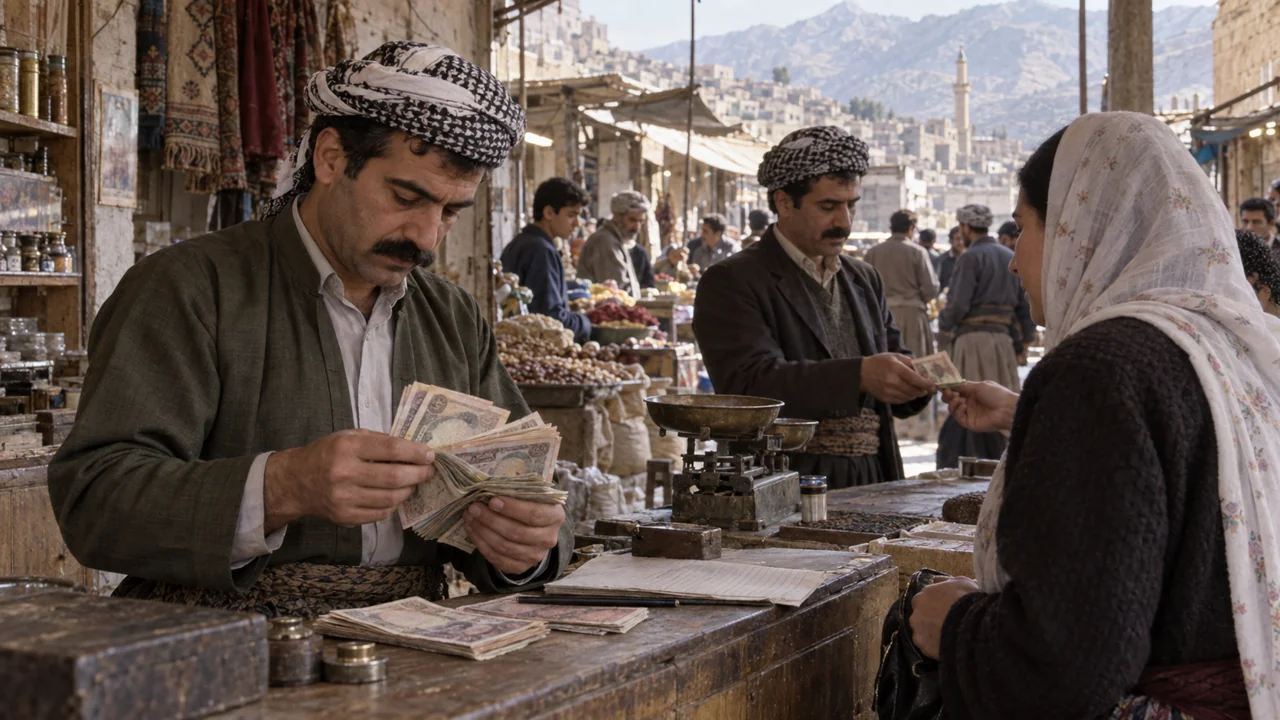
The Kurdish north, shielded since 1991 by a no-fly zone, had neither the time nor the counters. Some five of the seven billion twenty-five-dinar notes stayed stranded there. For want of anything else, people went on using them. No state guaranteed them, no authority managed their value, no press printed new ones. In the south, budget needs kept the presses running and inflation approached 250% a year. In the north the quantity of notes no longer moved, except to shrink with wear.
What follows is a matter of exchange rates. Trading at par in 1993, the two dinars drifted apart for good: about a hundred Saddam dinars per Swiss dinar from 1998 to January 2002, then three hundred in the spring of 2003. In October 2003 the Coalition Provisional Authority split the difference between the market price and purchasing power parity, and settled on 150 to 1.
What holds a currency up
The standard teaching is that a paper note is worth something because of the institution behind it. The Swiss dinar had nothing of the kind left: its issuer had publicly disowned it. Yet for eleven years it was the most stable money in the country. Two things held it up: a quantity that had become fixed, and the tacit agreement of a population with no other unit of account.
The lesson calls for caution. Scarcity and acceptance are enough to sustain a price, and that is the argument heard today about currencies with a capped supply. But a stock that cannot grow cannot adjust either: no lender of last resort, no fresh notes to replace the ones that tear, no recourse in a shock. The Swiss dinar did not prove that a central bank can be dispensed with; it made visible, in the negative, what a central bank does.
For eleven years, northern Iraq paid for its purchases with notes their issuer had declared void.